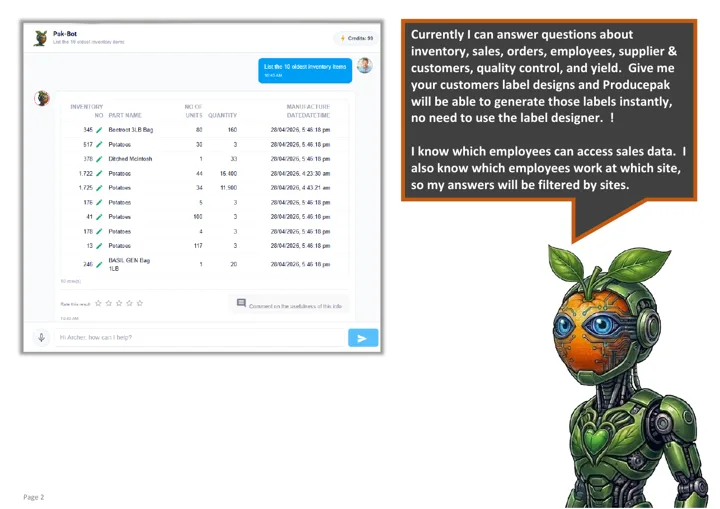
Material on this page draws on the ProducepakQI app guide, the Producepak app guide, the Pak-Bot guide and Producepak and Farmsoft quality control pages listed under Resources below.
The hidden cost of a manual QC program
Ask a produce business what its quality control costs and the first answer is usually the wages of the QA team. That is only part of the picture. A manual inspection program carries a long tail of costs that rarely appear in one place:
- printing, filing and storing paper inspection forms;
- typing results from paper into spreadsheets or systems at the end of a shift;
- phoning and emailing results to buyers, packing managers and suppliers;
- chasing missing forms before an audit;
- re-inspecting product because the first result was unclear or lost;
- disputes with suppliers that drag on because evidence is weak;
- product that deteriorates while a quality decision waits for the right person to see the result.
Farmsoft's quality control material claims that its software can reduce fresh produce waste, auditing and administration costs by 90 percent. Whatever your own figure turns out to be, the source of the savings is clear: most of the cost in a manual program is not the inspection itself but the handling of information around it.
Where digital, AI-assisted inspection saves money
No re-keying
When inspectors record results directly in Producepak QI on a phone or tablet, the data exists in the system the moment it is captured. There is no end-of-shift typing, no transcription errors and no lag between inspection and visibility.
No forms to design, print or file
The app can be configured with unlimited inspection programs. Changing a program changes it for every inspector immediately, with no reprinting and no risk of someone using last season's form.
Faster inspections
Flexible data entry lets inspectors add new records, such as a new supplier, as they go, without waiting for an administrator to set up a list. Reference images shown during inspection reduce hesitation over borderline defects. Once image recognition models are trained, AI can suggest results from photos so the inspector confirms rather than calculates.
Automatic reports and dashboards
Inspection reports, including photos, are produced by the app. QC dashboards show trends without anyone building them by hand. Pak-Bot can answer quality and yield questions in plain language, replacing many one-off report requests.
Instant communication
Each program decides who receives instant alerts, with photos and attachments. Instead of phoning a buyer, a packing manager and a supplier, the inspector completes the inspection and the alerts go out.
Audit preparation in minutes
When inspections, photos and corrective actions are stored together, audit evidence is a search away rather than a week of collecting folders.
A cost map for your QC program
Use this table to estimate where your own costs sit today. Fill in hours per week for each activity, then estimate how much each changes with digital inspection.
| Activity | Manual program | With Producepak QI |
|---|---|---|
| Recording inspections | Paper form, then re-keyed | Recorded once in the app |
| Photographing defects | Personal phones, sent by message | Unlimited photos attached to the test and shown on reports |
| Sharing results | Calls and emails | Automatic alerts to team members or suppliers |
| Building reports | Spreadsheets | Inspection reports, dashboards and Pak-Bot questions |
| Updating forms | Redesign and reprint | Edit the program once |
| Audit preparation | Collect and sort paper | Search inspection records |
| Supplier disputes | Weak evidence, long discussions | Photos, measurements and history |
How AI image recognition fits the cost picture
Image recognition is the most visible AI feature, and it is worth understanding its economics honestly. The ProducepakQI app guide explains that:
- it uses Microsoft Azure image recognition AI and blob storage;
- roughly five months of data gathering is needed before a model is built;
- building a model can take hours to days depending on dataset size;
- management can tweak the results a model returns and rebuild it;
- Azure AI processing carries variable fees based on the data stored, and custom model building is priced on application.

The practical lesson is to start capturing good photos from day one. Every inspection with consistent photos builds the dataset that makes future inspections faster. Meanwhile, the savings from digital recording, alerts and reports start immediately.
Lower cost per inspection, not fewer inspections
Cost reduction in QC should never mean inspecting less. The goal is to lower the cost of each inspection so that the business can afford to inspect at every control point. When each inspection takes less time and its results flow automatically, adding a pre-shipment check or a second receival sample becomes affordable. More checks at lower cost means fewer problems reaching customers, which is where the largest costs lie.
Rule of thumb: the cheapest quality problem is the one found at receival. The most expensive is the one found by the customer. Every saving in inspection time should be reinvested in catching problems earlier.
Licensing and running costs to plan for
When budgeting, consider the details in the ProducepakQI guide:
- a monthly subscription that can be upgraded or downgraded;
- 8 concurrent user licences included, with additional users priced on application;
- variable Azure AI processing fees based on the data stored;
- custom model building priced on application;
- API integration available for custom features.
Confirm current pricing with Producepak through the demo page, as plans and terms can change.
Measuring the savings
Before switching, record a baseline for a typical month:
- hours spent on inspections, data entry, reporting and audit preparation;
- number of supplier disputes and how long each took to resolve;
- quality-related credits and claims from customers;
- product written off for quality reasons.
Repeat the measurement three and six months after going live. Pak-Bot can help with the second measurement, for example by answering "rejected loads by supplier this quarter" or "waste by product last month", depending on how your data is recorded.
Cost questions from produce businesses
We only have one inspector. Is it worth it?
Small QC teams often gain the most, because the inspector's time is the scarcest resource. Removing re-keying and manual reporting frees a large share of that time.
Our inspectors are not comfortable with technology.
Inspection programs guide the inspector step by step, with reference images. Starting with one program on one commodity lets the team build confidence.
Do we need image recognition from day one?
No. Digital inspection, alerts and integration deliver savings from the start. Image recognition becomes available once enough data has been gathered.
Where inspection time actually goes
A useful exercise is to follow one inspection from start to finish in a manual program and note how much of the time is spent inspecting. For a typical receival inspection the sequence is: find the right form, write supplier and load details, take the sample, inspect and record, take photos on a personal phone, return to the office, type the results into a spreadsheet, email photos to the buyer, file the form. Often less than half of the total time is spent looking at product.
With Producepak QI, the sequence becomes: open the program, select or add the supplier, take the sample, inspect and photograph in the app, submit. Alerts and reports follow automatically. The inspection itself takes the same care; everything around it shrinks.
| Step | Manual | Producepak QI |
|---|---|---|
| Find form and enter load details | Paper, handwritten | Program opened in the app; supplier selected or added |
| Inspect and record | Handwritten | Recorded in the app with the right scoring method |
| Photos | Personal phone | Attached to the test |
| Data entry | Typed later | Not needed |
| Communication | Emails and calls | Automatic alerts |
| Filing | Paper files | Stored and searchable |
Costs that fall indirectly
Some of the largest savings do not show up as QC wages at all.
Fewer claims and credits
Better receival and pre-shipment inspections mean fewer problems reach customers, and stronger evidence means the claims that do arise are resolved faster and more fairly.
Less waste
When results reach decision-makers immediately, at-risk product is moved or redirected while it still has value.
Lower audit costs
Customer and certification audits take less preparation and less of the QA team's time when records are complete and searchable.
Better supplier performance
Suppliers who receive clear, prompt feedback improve, which reduces the cost of dealing with poor product in future seasons.
A phased approach that controls cost
Rolling out digital inspection in phases keeps costs predictable and lets savings fund the next step.
- Phase 1: receival. Digitise receival inspections for your highest-volume products. Savings in data entry and supplier communication start immediately.
- Phase 2: alerts and reports. Configure alert rules and dashboards so results reach decision-makers without manual effort.
- Phase 3: all control points. Add pre-pack, post-pack and pre-shipment programs, using the time saved in phase 1.
- Phase 4: AI image recognition. Once around five months of consistent photos and results exist, build models for the products where image recognition will save the most time.
- Phase 5: integration. Connect quality outcomes to grower payments, claims and your finance app so the cost of quality is visible in the accounts.
At each phase, compare the baseline measures recorded before you started. Phases that deliver less than expected can be adjusted before moving on.
The cost of not inspecting
When budgets are tight, inspections are sometimes cut back. The savings are visible immediately; the costs arrive later, as rejected deliveries, customer claims, write-offs and lost programs. Digital, AI-assisted inspection reverses that trade-off by making each inspection cheaper, so the business can afford to keep inspecting at every control point even when budgets are under pressure.
Who sees the savings
Savings from digital, AI-assisted inspection spread across the business. Inspectors spend more time on product and less on paperwork. Quality managers stop rebuilding reports. Buyers stop forwarding photos. Accounts spend less time on disputed claims. Owners see lower waste and fewer credits. Because each group sees part of the benefit, it is worth adding the savings up across departments when judging the return.
Inspection cost questions
How does digital inspection reduce costs?
It removes paper, re-keying and manual reporting, sends results automatically and makes audit evidence searchable, so inspectors spend their time inspecting.
What cost reduction does Farmsoft claim?
Farmsoft's quality control material claims up to 90 percent lower fresh produce waste, auditing and administration costs.
Are there extra costs for AI image recognition?
According to the ProducepakQI guide, Azure AI processing has variable fees based on the data stored, and custom model building is priced on application.
How many users are included?
The ProducepakQI guide lists 8 concurrent user licences, with additional users priced on application.