Material on this page draws on the ProducepakQI app guide, the Producepak app guide, the Pak-Bot guide and Producepak and Farmsoft quality control pages listed under Resources below.
Consistency is what customers really buy
Retailers and food service customers rarely complain about one bad delivery. What they cannot accept is unpredictability: good product one week, borderline the next, a rejection the week after. Consistent quality lets a retailer plan promotions, a restaurant plan its menu and a distributor promise its own customers. Suppliers who deliver it keep programs; suppliers who do not, lose them.
Consistency does not happen by accident. It comes from inspecting the same things, in the same way, against the same standards, every time, and from acting quickly on what the inspections show. AI-powered quality inspection supports each part of that.
Standardise inspections with programs
The ProducepakQI app can be configured with unlimited inspection programs and tests. That allows a program for every situation where the standard differs:
- by commodity: avocado, citrus, grapes, berries, leafy greens, potatoes, onions and so on;
- by stage: delivery, pre-pack, post-pack, pre-shipment;
- by customer: one program for each retailer specification;
- by product type: whole produce, fresh-cut, salads, IQF.
Farmsoft's quality control pages list inspection apps across a wide range of commodities, including leafy greens, fresh-cut, salads and coleslaw, grapes, citrus, avocado, strawberry, cherry, mango and berries, potato, onion, spinach, cucumber, asparagus, garlic, carrot, broccoli and beans, plus food service and IQF. Starting from programs designed for produce saves time and builds in good practice.
Choose the right scoring method for each test
Consistency depends on scoring each characteristic the right way. Producepak QI offers four methods.

| Method | Best for | Produce examples |
|---|---|---|
| Pass / fail | Yes-or-no conditions | Foreign matter, pest presence, packaging intact, label correct |
| Percent of sample | Defects measured by weight | Bruising, decay, sunburn, mechanical damage |
| Score | Overall characteristics rated on a scale | Appearance, colour, freshness, presentation |
| Value range | Measurements with limits | Brix, firmness, pulp temperature, pH, pack weight |
Using percent of sample for defects, rather than a vague "minor, moderate, severe", makes results comparable across inspectors, sites and seasons. Using value ranges for measurements means the specification is applied the same way every time.
Calibrate people with reference images
Even with clear scoring methods, judgement plays a part. Farmsoft's material describes quality officers viewing example defects in the app during the inspection, with images and links to documentation. Using the same reference images across every site and shift is one of the most effective ways to make inspectors consistent with each other.
A calibration routine
- Each month, select a sample of product with a range of defects.
- Ask each inspector to score it independently in the app.
- Compare results and discuss differences against the reference images.
- Update reference images where the standard was unclear.
AI image recognition trained on your product
Image recognition adds another layer of consistency. A model built from your own inspection photos applies the same reading of a defect every time, whatever the inspector's experience or the time of day. According to the ProducepakQI guide, Producepak QI uses Microsoft Azure image recognition AI; models are built after roughly five months of data gathering; building takes hours to days depending on dataset size; and management can tweak the results returned and rebuild the model.

Getting good training data
- Photograph samples in consistent light and from a consistent distance.
- Attach photos to the specific test that the defect relates to.
- Make sure inspectors record results accurately; the model learns from them.
- Include both good and defective product so the model learns the difference.
Keep people in charge. AI suggestions should always be confirmed by the inspector. Management review of model results, as the QI guide describes, is part of keeping the model aligned with your standards.
Meet retailer specifications every time
Producepak's quality control page lists specifications for Walmart, Whole Foods, Tesco, Woolworths, Coles, Aldi and IGA, and Farmsoft's material also mentions Loblaws. Building an inspection program around each customer's specification means the product is checked against the standard the customer will apply at its own dock. Where several customers buy the same product with different specifications, separate programs keep the differences clear.
Watch the trends, not just the results
Consistency is a trend, not a single result. Producepak QI tracks supplier performance and quality trends, and QC dashboards show them over time. Useful views include:
- average quality score by supplier by week;
- defect frequency by type over the season;
- results by inspector, to spot calibration drift;
- results by site, for multi-site operations;
- pre-shipment failures by customer.
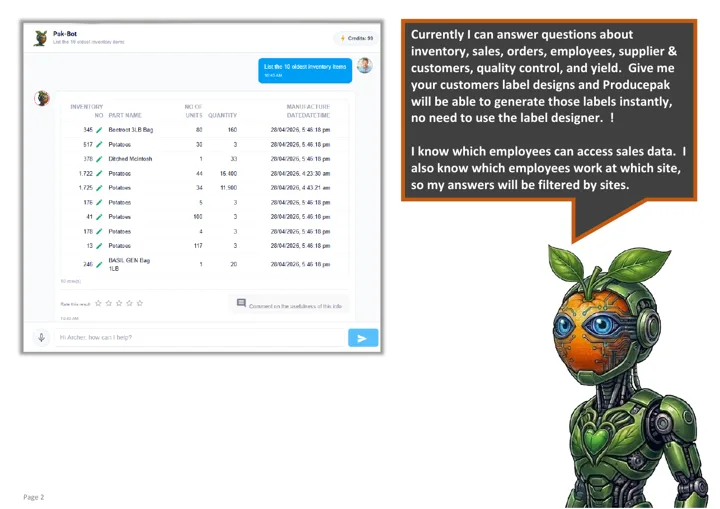
Pak-Bot answers questions about quality control and yield, so trends can be requested in plain language, for example "average quality score by grower this season" or "chart rejected loads by supplier by month".
Consistency through the HACCP lens
Producepak's quality control app is based on the HACCP method of risk assessment and mitigation, covering microbiological, chemical and physical hazards. HACCP is itself a consistency system: identify critical control points, set limits, monitor every time, act when limits are breached, verify and keep records. Inspection programs, value-range limits, alerts and stored records map directly onto those principles.
Consistency across sites and shifts
Businesses with several packhouses, or with day and night shifts, often find that quality varies more between sites and shifts than between suppliers. The causes are usually different interpretations of the same standard, different equipment settings or different levels of experience. Running the same inspection programs, with the same reference images and the same scoring methods, everywhere is the first step to closing those gaps. Reviewing results by site and by inspector shows where calibration or training is needed.
| Source of inconsistency | Signal in the data | Response |
|---|---|---|
| Inspector interpretation | One inspector rejects far more or less than others | Calibration session with reference images |
| Site differences | Same supplier scores differently at two sites | Align programs, equipment and training |
| Shift differences | Night shift results differ from day shift | Check lighting, staffing and supervision |
| Seasonal drift | Scores decline late in the season | Tighten receival checks and supplier communication |
| Supplier variability | Wide spread of results for one supplier | Share results and agree improvement actions |
Consistency from the field to the customer
Quality consistency starts before product reaches the packhouse. When suppliers receive inspection results promptly, with photos, they can adjust harvest timing, handling and cooling. Sharing the same specifications and reference images with key growers means everyone works to the same picture of good product. The ProducepakQI guide describes alerts that can go to suppliers as well as team members, which makes this feedback routine rather than occasional.
At the other end, pre-shipment inspections against each customer's specification confirm that the consistency achieved in the packhouse survives to the loading dock. Together, these checks create a closed loop: suppliers learn what good looks like, the packhouse checks it at each stage, and customers receive product that matches the standard every time.
Measuring consistency
Consistency can be measured, not just felt. Useful measures include the spread of quality scores for each product, the share of inspections within specification, the number of customer rejections per hundred deliveries and the difference between sites or inspectors. Review them monthly and set targets for improvement. When the spread narrows, customers notice, even if the average stays the same.
A consistency programme in six steps
- Define the standard. Write each product's specification, using customer specifications where they apply.
- Build the programs. One per product, stage and customer standard, with the right scoring method for each test.
- Add reference images. Clear examples of each defect at each severity.
- Train and calibrate. Run calibration sessions so inspectors score alike.
- Monitor trends. Review dashboards and ask Pak-Bot for trends weekly.
- Act and improve. Share results with suppliers, adjust programs and rebuild AI models as data grows.
Consistency and your brand
For businesses selling under their own brand, consistency is the brand. Shoppers who buy a branded punnet of berries or bag of salad expect the same experience every time. A single poor experience can lose a customer for good. Inspection programs for branded lines can be stricter than for commodity product, with tighter value ranges and additional appearance scores, and pre-shipment checks can be mandatory for every branded order. Producepak QI's unlimited programs make it easy to apply a higher standard where the brand depends on it.
Consistency and grower relationships
Consistent inspection is also fairer to growers. When every load is assessed the same way, by calibrated inspectors using the same scoring methods and reference images, growers can trust that a downgrade reflects their product rather than who happened to be on shift. That trust makes growers more willing to act on feedback, which in turn improves the consistency of supply. Sharing results promptly through supplier alerts completes the loop.
Common consistency pitfalls
| Pitfall | Effect | Fix |
|---|---|---|
| Too many programs that differ slightly | Inspectors pick the wrong one | Merge similar programs; name them clearly |
| Descriptive scales instead of measurements | Results vary by inspector | Use percent of sample and value ranges |
| Reference images taken in poor light | Inspectors cannot compare reliably | Retake in consistent light |
| Nobody reviews AI suggestions | Model drifts from your standard | Management reviews results and rebuilds models |
| Trends reviewed only at season end | Problems found too late | Weekly trend review |
Consistency in fresh-cut and processed lines
Fresh-cut salads, coleslaw and IQF products bring their own consistency challenges: raw material varies, but the finished product must look and taste the same every day. Inspecting raw material at receival, then the finished product after processing, with the same programs each shift, shows whether variation is coming from supply or from the process. Farmsoft's quality pages include programs for leafy greens, fresh-cut, salads, coleslaw and IQF, so processors can start from produce-specific tests rather than generic food checklists. Linking those inspections to production yield through Producepak makes the cost of inconsistent raw material visible.
Quality and consistency questions
How many inspection programs can I create?
Unlimited, according to the ProducepakQI guide.
Which scoring methods are available?
Pass or fail, percent of sample, score, and value range.
How does AI improve consistency?
An image recognition model trained on your own inspection photos applies the same reading of defects every time, with management able to review, tweak and rebuild it.
Can I inspect against retailer specifications?
Yes. Producepak's quality control page lists specifications for retailers including Walmart, Whole Foods, Tesco, Woolworths, Coles, Aldi and IGA.