
Why growers keep calling
Any business that packs, stores or sells produce on behalf of growers knows the pattern. The phone rings, and the grower asks one of three questions. How much of my product do you still have? How did it pack out? What did it sell for? The answers matter to the grower's cash flow, harvest planning and confidence in the relationship. Yet in many sheds, each answer means someone stopping what they are doing to search a system, add up a spreadsheet or promise to call back.
Multiply that by dozens of growers across a season and grower communication becomes a significant workload, usually carried by a few experienced people. When those people are busy, growers wait, and growers who wait start talking to other packers.
Pak-Bot gives marketers, packers and grower groups a faster way to answer. The questions growers ask map directly onto questions the chatbot can answer from Producepak, and the answers can be emailed to the grower from the same conversation.
The three grower questions, answered by AI
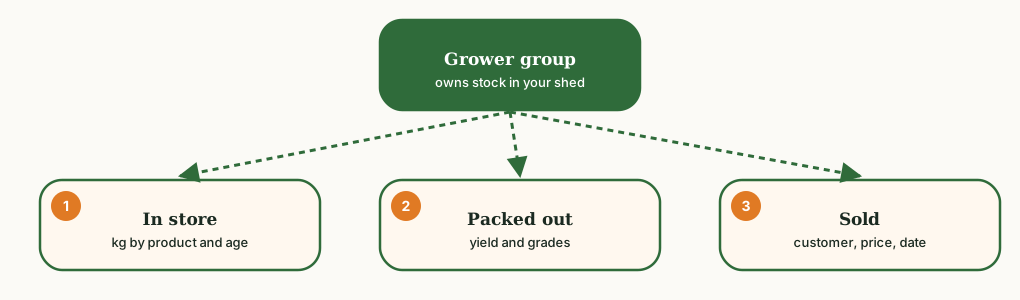
1. "How much of mine is still in your shed?"
Producepak tracks who owns each item of inventory. Totals of inventory owned by ACE Farming Group returns the grower group's stock currently held. Follow-ups split it by product, by age or by site: "inventory owned by ACE Farming Group by product", "ACE Farming Group stock older than 7 days".
2. "How did it pack out?"
Because intake and packing outputs are recorded against lots, packout can be reported for a single delivery or a whole season: "packout by lot for ACE Farming Group this month", "average first-grade percentage by grower this season". The grower sees the result of their fruit, not an average across the shed.
3. "What did it sell for?"
For users with sales access, questions such as "sales of product owned by ACE Farming Group this month by customer" show where the product went. Combined with Producepak's grower payment features, this gives growers a transparent picture between settlement statements.
Consignment and ownership in produce
Consignment is common in fresh produce. A grower delivers product to a packer or marketer, who stores, packs and sells it, then pays the grower based on the outcome, less agreed charges. The arrangement only works with trust, and trust depends on timely, accurate information.
Ownership also matters for businesses that store product for others, such as third-party cool stores, or that pack for multiple grower groups on the same lines. Mixing up whose product is whose leads to disputes and incorrect payments. Producepak records ownership at the inventory level, which is what allows Pak-Bot to answer ownership questions precisely rather than by approximation.
| Arrangement | Typical grower question | Chatbot question |
|---|---|---|
| Packing for a fee | How did my fruit grade? | Packout by lot for ACE Farming Group this week |
| Consignment selling | What has sold and what is left? | Totals of inventory owned by ACE Farming Group |
| Cool storage | How much is in store and how old is it? | ACE Farming Group stock by age |
| Grower group marketing | How are we doing against other growers? | Average packout by grower this season |
Quality feedback growers can use
Growers improve when they get specific, timely quality feedback. "Your fruit was poor last week" is not actionable. "Three of your five loads this week had more than 8 percent bruising, mostly in the afternoon deliveries" is. Producepak's quality inspections capture defects, scores and photos; Pak-Bot turns them into summaries.
- Rejected loads by grower this season
- Most common defects for ACE Farming Group this month
- Average quality score for ACE Farming Group by month
- Receival temperature failures by grower last week
Shared regularly, these summaries help growers fix problems in harvest timing, handling, cooling and transport. They also give the packer an objective basis for difficult conversations about rejected or downgraded product.
Emailing growers directly from the chatbot
Pak-Bot can email any answer. Instead of copying figures into a message, the grower liaison asks for the result and sends it in the same step, for example "Email inventory owned by ACE Farming Group to the grower contact". A short weekly email to each grower, covering stock in store, packout and quality, takes minutes to send and prevents many of the calls that would otherwise arrive.
Check before you send: for anything going outside the business, view the answer on screen first, then ask Pak-Bot to email it. That way the grower gets exactly what you intended.
Grower reporting through the season
Grower information needs change through the year. A simple calendar keeps reporting consistent.
Before the season
Review last season's intake, packout and quality by grower: "total weight received by grower last season", "average packout by grower last season". Use the results in pre-season planning conversations about volumes, varieties and harvest windows.
During the season
Send weekly updates on stock in store, packout by lot and quality. Watch for growers whose results are slipping, and call them while there is still time to adjust.
After the season
Summarise each grower's season: intake, packout, quality, sales and timing. Producepak's grower payment features handle the settlement calculation; the chatbot provides the supporting picture.
Grower payments and administration
Producepak includes grower payment processing, and its website reports a 90 percent reduction in grower payment administration costs for its customers. Grower payment calculations depend on the same records Pak-Bot reads: received weights, packout, sales and charges. Faster access to those records means fewer queries during settlement and fewer surprises for growers when statements arrive.
Who in the business uses grower questions
Grower liaison
Answers grower calls with live figures, sends weekly updates and prepares for grower meetings.
Quality manager
Shares inspection summaries with growers and tracks improvement over the season.
General manager
Reviews grower performance when planning intake, programs and pricing for the next season.
Accounts
Answers settlement questions with the underlying intake, packout and sales data at hand.
Respecting grower confidentiality
Growers expect their information to stay private, both from the public and from other growers. Pak-Bot applies Producepak's role-based access: only employees whose role allows sales data can see sales figures, and site assignments limit what each employee sees. Business data, excluding the wording of prompts, stays on Producepak servers rather than being sent to ChatGPT. When emailing growers, send each grower only their own results.
A weekly grower update in five questions
Consistency matters more than detail in grower communication. A short update that arrives every week builds more trust than a long report that arrives when someone has time. Using Pak-Bot, a grower liaison can prepare each grower's update from five questions:
- Totals of inventory owned by ACE Farming Group for current stock in store.
- "ACE Farming Group stock older than 7 days" to flag product that needs to move.
- "Packout by lot for ACE Farming Group last week" for packing results.
- "Rejected loads for ACE Farming Group last week" for quality exceptions.
- "Sales of product owned by ACE Farming Group last week by customer" for users with sales access.
Each answer can be emailed to the grower contact. For a business working with thirty growers, the whole round takes a fraction of the time that building thirty spreadsheets would.
Using grower data in pre-season planning
The best time to use grower data is before the season starts, when there is still room to change plans. Questions that inform planning include:
- Total weight received by grower last season
- Average packout by grower last season
- Weekly intake by grower last season
- Rejected loads by grower last season
Weekly intake by grower shows how deliveries were spread through the season. If several large growers peaked in the same weeks, packing capacity was probably stretched while other weeks were quiet. Sharing that picture with growers can help spread harvest timing, varieties or plantings, which in turn smooths labour and cool room demand for the packer.
Average packout by grower over a full season is a fairer measure than a single bad week. Growers with consistently strong packout may justify longer-term programs or premium pricing; growers with consistently weak packout may need agronomic support or a frank conversation about fit.
Handling disputes with data
Disagreements between growers and packers are a normal part of the industry: a downgrade the grower thinks was unfair, a sale price lower than expected, a quantity that does not match the grower's records. They are resolved faster when both sides look at the same facts.
Downgrades and rejections
Producepak inspections record measurements, defects and, where templates include them, photos. A summary such as "defects for ACE Farming Group lot 4471" gives the conversation an objective starting point.
Quantity differences
Received weights and counts recorded at intake can be compared with the grower's dispatch records. "Weight received from ACE Farming Group by delivery this month" lists each delivery so any gap can be traced to a specific load.
Price outcomes
For users with sales access, sales by customer and date show what the grower's product actually sold for and when. Seen against the market at the time, this usually explains a disappointing return better than any general reassurance.
Grower groups and cooperatives
Grower-owned packhouses and cooperatives face a particular challenge: the growers are also the owners, and they want transparency about both their own results and the operation as a whole. The chatbot helps on both fronts. Individual results go to individual growers. Aggregate measures, such as total intake, overall packout and sales by market, can be shared with the board. Role and site settings keep each grower's detailed information private from other members unless the business chooses otherwise.
Measuring the improvement
To see whether AI grower reporting is working, track a few simple measures before and after rollout: the number of grower calls asking for stock, packout or sales information each week; the time the grower liaison spends preparing updates; and how many growers receive a regular update. Many businesses find the largest change is not in time saved but in consistency, because every grower now gets the same quality of information on the same day each week, instead of the growers who call most often getting the most attention.
Growers who sell through several channels
Larger growers often split their crop between several packers, marketers or export programs. They compare results across those channels closely, and the channel that reports fastest and most clearly has an advantage. A packer or marketer that sends a reliable weekly update, with stock, packout, quality and sales figures drawn from live records, gives growers a reason to send more of their crop that way. In a competitive supply market, timely information is part of the service a grower is choosing, alongside price, packing quality and market access.
Clear reporting also protects the relationship in difficult seasons. When prices are low or quality suffers after poor weather, growers who have seen consistent figures all season are more likely to accept the outcome than growers who receive a surprise at settlement time.
Fast, accurate grower reporting is ultimately a supply strategy. The packers and marketers that growers trust most are usually the ones that tell them what is happening without being asked. An AI chatbot does not replace the personal relationship between a grower and the people who handle their crop, but it gives those people the facts they need to make every conversation useful.
Grower reporting questions
Can the chatbot show stock owned by a particular grower?
Yes. Producepak records inventory ownership, so questions such as "Totals of inventory owned by ACE Farming Group" return that grower's stock.
Can it report packout for a single delivery?
Yes, where intake and packing outputs are recorded against the lot. Ask for packout by lot for the grower and period.
Can growers log in and ask Pak-Bot themselves?
Pak-Bot answers questions for Producepak users according to their roles and sites. The simplest approach is for staff to ask on the grower's behalf and email the result. Ask Producepak about access options for growers.
Does it calculate grower payments?
Grower payments are calculated by Producepak's grower payment features. Pak-Bot helps by answering questions about the intake, packout and sales behind them.