
Trading fresh produce is a data problem
Wholesalers, distributors, importers and exporters make money in the gap between buying and selling perishable product. That gap is narrow, and it closes quickly. Prices move by the day, product quality changes by the hour, and customers change their minds between ordering and receiving. Success depends on knowing, at any moment, what is available, what has been promised, what each customer actually buys and where the margin is.
Most trading businesses hold all of that information somewhere. The difficulty is assembling it fast enough. A salesperson quoting availability to a chef at 6 am cannot wait for an office report. A trading manager reviewing a slow week cannot spend an afternoon building pivot tables. An importer deciding how quickly to clear a container needs today's arrival inspection, not last week's summary.
Pak-Bot, the AI chatbot inside Producepak, puts those answers in reach of anyone with the right access. Questions are written in plain English; answers come back from live records as totals, tables or charts.
Customer intelligence for the sales desk
A distributor might serve hundreds of customers: supermarkets, independent grocers, restaurants, caterers, institutions and other wholesalers. Knowing each account well is impossible without help. The chatbot provides that help.
Account snapshots
Before a call or visit, a sales rep can ask "Loblaws sales by product last quarter" or Woolworths sales of baby spinach this year and arrive with facts rather than impressions.
Concentration risk
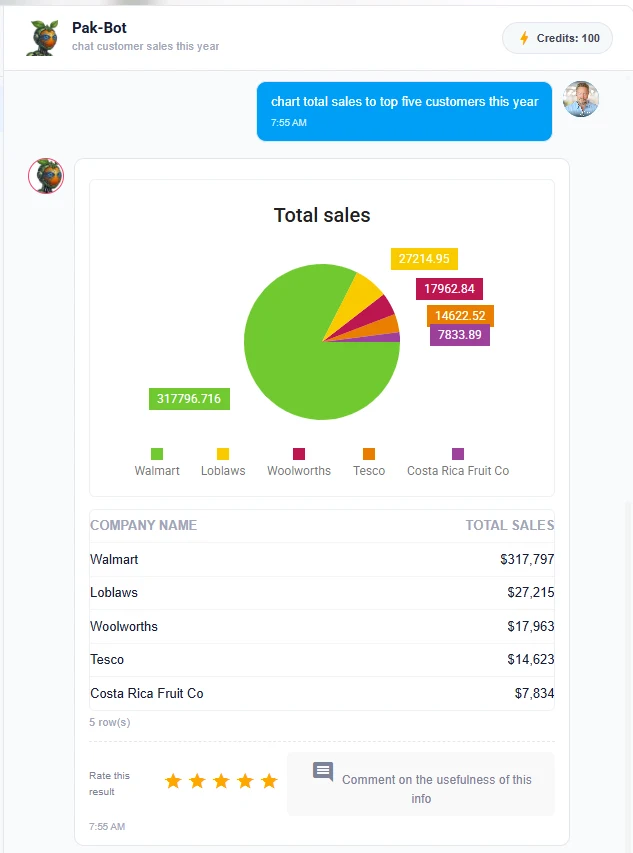
chart total sales to top five customers this year produces a ranked chart in seconds. In many trading businesses, the result is sobering: one or two customers account for a large share of revenue. Seeing that clearly is the first step to managing it.
Drifting accounts
Customers rarely announce that they are moving to a competitor; their orders just shrink. Asking "customers with lower sales this month than last month" or "customers who have not ordered in 30 days" each week turns a silent drift into a call list.
Regional patterns
Sales by state last month shows where volume is going. For distributors running their own trucks or consolidating freight, regional patterns feed directly into route and transport planning.
Fill rate: what was ordered against what was shipped
In produce, the order and the delivery are often different. Supply falls short, product fails inspection, substitutions are made, or the customer amends the order after picking. Large retailers track supplier fill rate closely and raise it in supplier reviews.
Walmart orders vs sales Q1 2026 compares ordered quantities with what was invoiced over a period. Follow-up questions drill into which orders and which products fell short. Arriving at a supplier review already knowing your own fill rate, and the reasons behind each shortfall, changes the tone of the conversation.
| Question | What it reveals |
|---|---|
| Walmart orders vs sales Q1 2026 | Overall fill for one customer over a quarter |
| Orders vs sales by customer last month | Which accounts are being short-shipped most |
| Products with the largest gap between ordered and shipped this month | Where supply is falling short |
| Short-shipped orders last week | Orders to follow up with customers |
Availability you can quote with confidence
Quoting availability is the most frequent question on any produce trading desk, and the one most often answered from memory. A wrong quote either leaves product unsold or creates a short-shipment. With Pak-Bot, the rep asks Total yellow potato in stock or "avocados count 20 in stock" and quotes from the live figure.
For businesses with several warehouses, stock by site matters as much as the total. A rep in one city can see what is available in another and offer a transfer rather than a "no". Site filtering also works in reverse: warehouse staff assigned to one location see only that location's stock.
Age-aware selling
Selling the oldest product first protects margin. A trading desk that checks List the 10 oldest inventory items each morning can steer customers who are flexible on specification toward product that needs to move, while it still sells at a good price.
Purchase orders in every format
Distribution businesses receive orders in more formats than almost anyone: retailer PDFs, food service spreadsheets, emails from independent grocers, photos of handwritten order sheets, messages relayed by sales reps. Keying them in is slow, and keying errors become wrong deliveries.
Pak-Bot converts customer documents into orders. It reads the document, finds the customer, delivery date and order lines, matches them to Producepak products and prepares an order for a staff member to check and release. Retailers that support EDI can continue to use it; document conversion covers everyone else. The order automation page walks through the process.
Import and export operations
International produce trade adds lead time, documents and risk. A container of grapes or citrus may spend weeks in transit, then need fast decisions on arrival.
Arrival quality
Arrival inspections recorded in Producepak let the chatbot answer "inspection results for this week's arrivals" or "defects by shipper this season". Those records support claims against shippers and decisions on which consignments to sell first.
Selling down a consignment
Questions such as "stock remaining from container MSKU1234567 by size" or "sales of that container's product by customer" track how quickly a shipment is clearing. When consigned product is sold on behalf of an exporter or grower, the same visibility supports settlement. See grower and consignment reporting.
Destination analysis
Exporters can ask about sales by destination country, by customer and by product to see which markets are growing and which are softening.
Margin and price questions
Trading margin in produce is earned or lost one line at a time. Where buy prices and sell prices are recorded in Producepak, the chatbot can help people with sales access look at the spread: sales value by product, average selling price by customer, or products whose selling price has fallen over recent weeks. Pricing data is sensitive, which is why Pak-Bot's role filtering matters; only people whose role allows sales data will see these answers.
Keep it consistent: when comparing periods, compare complete periods or the same number of trading days, and be clear whether you want sales before or after credits. Small differences in definition produce big differences in produce margins.
Sending answers to the people who need them
Distributors share numbers constantly: with sales reps, managers, suppliers and customers. Pak-Bot can email or print any answer. Email Angela Coles sales from Q1 runs the analysis and sends it in one step. A trading manager can email the week's sales by customer to the team every Monday without building a file.
A weekly rhythm for a distribution business
| Day | Question | Owner |
|---|---|---|
| Monday | Total sales last week compared to the week before | General manager |
| Monday | Orders vs sales by customer last week | Sales manager |
| Daily | List the 10 oldest inventory items | Warehouse and sales |
| Wednesday | Customers who have not ordered in 30 days | Sales reps |
| Friday | Chart sales by state this week | Logistics |
| Month end | chart total sales to top five customers this year | Owner |
None of these requires an export. Each takes seconds, and the habit of asking surfaces problems while they are small.
Connected to the rest of the operation
Producepak covers order picking with scan-based allocation, dispatch, bills of lading, invoicing, export documents and links to Xero, QuickBooks, MYOB and Sage. Because orders, inventory, quality and invoices share one system, the chatbot can answer questions that cross those boundaries, such as why a customer's invoiced quantity was below the order. That is where a produce-specific assistant earns its place over a spreadsheet or a general chatbot; see the comparison.
Food service distribution
Food service customers, such as restaurants, hotels, caterers, schools and hospitals, behave differently from retail. They order frequently, often daily, in smaller quantities, with strong preferences on specification and delivery times. Their orders arrive by email, text and phone as often as by system. A food service distributor's margin depends on handling high order volume efficiently and keeping customers loyal through reliability.
For food service, the most useful chatbot questions tend to be:
- Orders for delivery tomorrow by customer
- Customers who have not ordered in 14 days
- Average order size by customer this month
- Short-shipped orders yesterday
Combined with purchase order capture from emails and photos, these help a food service distributor handle more customers without adding office staff, and spot lapsing accounts before they are lost.
Retail supply programs
Retail programs bring volume and structure, along with strict specifications, labelling requirements and supplier performance reviews. The chatbot supports retail supply in three ways. Fill rate questions show performance before the retailer raises it. Customer-specific labels, generated from templates, reduce rejections at distribution centres. And product-by-week sales for each retailer show how promotions and seasonality affect demand, which feeds back into supply planning.
Managing the trading floor's information flow
On a busy produce trading floor, information moves by voice: across desks, over the phone, in quick messages. Numbers quoted from memory travel fast and are often wrong. Encouraging traders to check a figure with the chatbot before quoting it, whether stock, a customer's recent volume or the oldest product available, raises the quality of every conversation with customers and suppliers. Because each trader sees data allowed by their role, sensitive information such as other traders' margins can be kept private if the business wishes.
Supplier performance for buyers
Distributors buy as well as sell. Buyers need to know which suppliers deliver on time, in full and at the expected quality. Where receivals and inspections are recorded in Producepak, the chatbot can answer questions such as "top 10 suppliers by weight received this year", "rejection rate by supplier this quarter" and "suppliers of red onion this season". Those answers support negotiations, program allocation and decisions about where to source when supply is short. They also give buyers an objective basis for difficult conversations with suppliers whose quality has slipped.
Credits, returns and claims
Every distributor deals with credits: product rejected at delivery, quality complaints after arrival, short-shipments and pricing disputes. Credits erode margin quietly, and their causes are often spread across many small incidents. Where credits are recorded with reasons in Producepak, questions such as "credits by customer this quarter" or "credits by reason last month" show where the losses come from. A cluster of quality credits on one product may point to a supplier; a cluster on one customer may point to a specification misunderstanding; a cluster on one route may point to transport temperature. Each pattern leads to a specific fix that a total figure on its own would never reveal.
Distribution is a business of many small decisions made quickly. Each one is better when it rests on a current figure rather than a guess. Putting those figures one question away from every trader, buyer and warehouse lead, filtered to what each person should see, is the practical promise of AI for produce distributors.
Questions from distributors
Can sales reps use the chatbot on the road?
Yes. Producepak runs on phones and tablets, and questions can be typed or spoken. Each rep sees data allowed by their role.
Can it compare what a customer ordered with what was shipped?
Yes. Questions such as "Walmart orders vs sales Q1 2026" compare ordered and invoiced quantities.
Do customers have to change how they send orders?
No. Pak-Bot is designed to read the purchase order documents customers already send. EDI remains available where customers use it.
Can warehouse staff see customer pricing?
Not unless their role includes sales access. Pak-Bot filters answers by role and site.
Does it work across multiple warehouses?
Yes. Ask for stock by site, or name a site in the question. Users assigned to one site see that site's data automatically.