
What fresh produce AI actually means
"AI" has become a label on almost every software product, so it is worth being precise. In the fresh produce industry, useful artificial intelligence does one thing above all: it shortens the distance between a question and a reliable answer. The answers already exist inside your operational records. Every bin received from a grower, every carton packed, every inspection, every pallet shipped and every invoice raised is data. The problem has never been a lack of data. It has been the effort needed to get a specific answer out of it before the moment to act has passed.
Pak-Bot is the Farmsoft team's answer to that problem. It is a conversational assistant that sits inside Producepak, the produce management platform that follows Farmsoft. People type or speak a question in ordinary English, such as Total yellow potato in stock or Walmart orders vs sales Q1 2026, and Pak-Bot replies with a figure, a table or a chart built from the business's own live records.
That last point is what separates produce-specific AI from a general chatbot. A general chatbot can explain what packout means. It cannot tell you what your packout was on Tuesday's Hass run. Pak-Bot can, because it is connected to the system where that run was recorded.
Five jobs an AI chatbot does in a produce business
1. Answers questions
Stock on hand, oldest pallets, sales by retailer, fill rates, packout, inspection results. Anyone with the right access can ask.
2. Draws charts
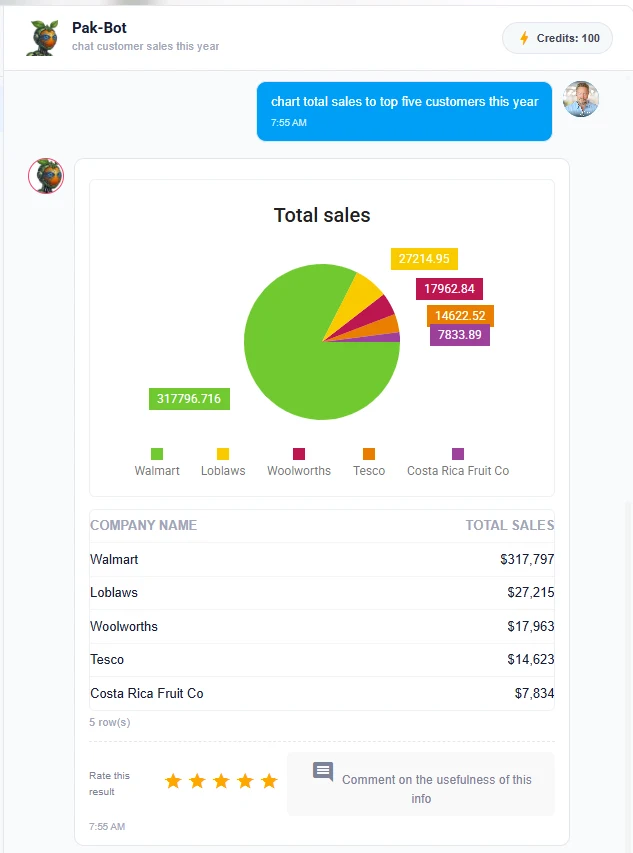
Ask for a chart and get one, with the table of values underneath so the figures can be checked.
3. Sends results
Ask Pak-Bot to email a result to a colleague, a grower or yourself, or print it for the floor.
4. Prints labels
Once a customer's label design is loaded, labels for that customer come from a request rather than a design session.
5. Reads orders
Customer purchase orders that arrive as documents are turned into orders in the system for staff to check and release.
Each of these jobs is covered in depth elsewhere on this site. This page explains the idea, who it is for and how it works.
Who fresh produce AI is built for
Produce businesses vary enormously, from a single-site vegetable packer to a multi-country importer. The common thread is perishable product, many small decisions every day and a workforce that is often away from a desk. Pak-Bot is designed around those conditions.
Fruit and vegetable packers
Packers juggle intake, cool room space, packing lines, labour and dispatch windows. The questions are constant and time-sensitive: what is in the totes, what is getting old, what has to go on the 6 am truck. See packhouse AI.
Wholesalers, distributors, importers and exporters
Trading businesses live on availability, customer behaviour and margin. They receive orders in every format and need to know quickly what each customer bought, ordered and was short-shipped. See AI for produce distributors.
Marketers and grower groups
Businesses that pack or sell on behalf of growers need to keep those growers informed. See AI grower reporting.
Fresh-cut processors and food service suppliers
Processors convert raw product into cut, mixed and packaged lines, often under tight specifications. Yield, quality and traceability questions are daily routine, and Pak-Bot answers them from the same data that drives production.
How the chatbot turns a sentence into an answer
Under the surface, a question to Pak-Bot passes through four stages. Understanding them helps explain why the answers can be trusted and where human judgement still matters.
- Interpretation. A large language model reads the sentence and works out the intent: the measure (weight, units, value, percentage), the subject (a product, customer, site, grower or packaging type), the grouping and the time period.
- Permission filtering. Pak-Bot checks who is asking. It knows which employees are allowed to see sales data and which sites each employee works at, and restricts the request accordingly.
- Retrieval. A query runs against Producepak's records. The numbers come from the database, not from the language model's general knowledge.
- Presentation. The result comes back as a figure, a table or a chart, and can be emailed or printed on request.
Why the data stays put
Produce businesses are rightly cautious about handing commercial information to outside AI services. Customer prices, grower settlements and retailer volumes are sensitive. The Pak-Bot guide is explicit about this: business data, apart from the wording of prompts, is not sent to ChatGPT and stays on Producepak servers. The language model helps understand the question; the records that answer it are read inside Producepak.
Permissions travel with every request. A cool room operator who asks about sales will not get sales figures unless their role allows it. A supervisor at one site sees that site. Because these rules come from existing Producepak user settings, there is no second permission system to configure for the AI. The comparison with general chatbots covers this in more detail.
Questions people ask on day one
The fastest way to understand fresh produce AI is to look at real requests. These come from the Pak-Bot guide:
- Email Angela Coles sales from Q1
- Woolworths sales of baby spinach this year
- Total sales last month
- Sales by state last month
- Total yellow potato in stock
- Weight of totes in stock
- Totals of inventory owned by ACE Farming Group
- Total of inventory at site Closters
- Walmart orders vs sales Q1 2026
- Red onion in poly bags
Notice the variety. Some are about stock, some about sales, one is about consigned inventory, one is about a specific site, and one sends an email. None needs a report menu, a filter screen or a spreadsheet.
What a good question looks like
Pak-Bot copes with loose wording, but the most dependable questions share a shape. They name what is being measured, what it is about, how it should be split and which period it covers. "How are spuds going?" leaves the assistant guessing. "Sales of washed potatoes by customer last month" leaves nothing to guess.
| Vague | Specific | Why it works better |
|---|---|---|
| How much onion have we got? | Red onion in poly bags | Names the product and the pack format, so raw and finished stock are not mixed |
| How did sales go? | Total sales last month | Sets a clear period |
| Is Walmart happy? | Walmart orders vs sales Q1 2026 | Turns a feeling into a measurable comparison |
| What's in the shed for ACE? | Totals of inventory owned by ACE Farming Group | Uses the owner name as recorded in the system |
Adding a word such as "chart", "list" or "total" also controls the format of the reply. The analytics page has more on building questions that return exactly the view you need.
Where the time savings come from
It is tempting to measure AI by the seconds saved on each query, but the larger gains in produce come from three side effects.
Fewer interruptions
In most produce businesses, two or three people field a stream of "can you pull the numbers for..." requests. Each one breaks their concentration. When the person asking can get the answer directly, those interruptions disappear, and the people who used to answer them get their day back.
Earlier decisions
Perishable product rewards early action. Seeing that a lot of berries is ageing at 10 am instead of 4 pm can be the difference between full price and a markdown. Questions that are easy to ask get asked more often, so problems surface earlier.
Fewer copies of the truth
Spreadsheet exports multiply. Each copy is a snapshot that starts going stale immediately, and different people make decisions from different snapshots. Every Pak-Bot answer comes from the live record, so the sales manager and the warehouse see the same number.
Built on the platform underneath
An AI assistant is only as good as the records it reads. Pak-Bot inherits the depth of Producepak, which covers receival, inventory, packing, quality inspection, traceability and recall, order picking, dispatch, logistics, invoicing and grower payments, with accounting links to Xero, QuickBooks, MYOB and Sage. Producepak tracks product from grower to customer, which is why Pak-Bot can answer questions that cross departments, such as comparing what a retailer ordered with what was actually invoiced.
For businesses still on Farmsoft, the original platform remains available until 2028, which gives time to plan a move to Producepak and Pak-Bot outside the peak season. The adoption guide sets out a practical sequence.
Learning from the people who use it
Pak-Bot is candid about being a work in progress. Its own introduction says it is still learning and invites feedback that the team uses for training. Every reply carries a five-star rating and a comment box. When a user writes "Closters is a site, not a customer" or "I meant 2 kg bags only", that comment goes to the Producepak team and shapes how Pak-Bot reads similar questions in future. Over time, the assistant learns the vocabulary of the businesses that use it.
This also means the best results come from teams that rate answers routinely, not only when something goes wrong. A positive rating is a signal that a particular reading of a question was right.
Where AI fits and where people still decide
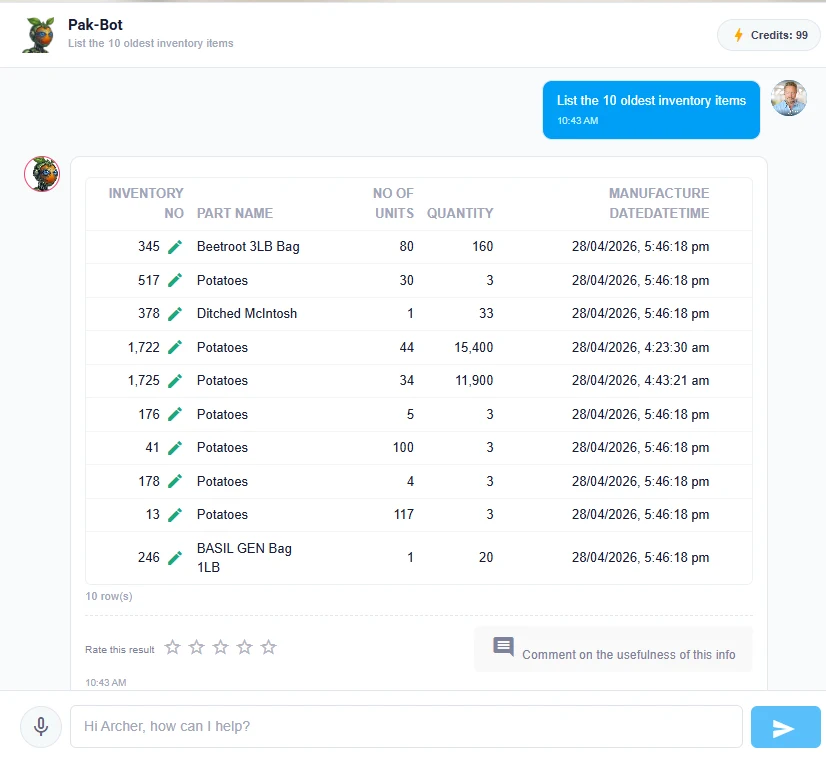
Fresh produce AI is a tool for finding and moving information. It is not a substitute for the judgement of an experienced packhouse manager, buyer or quality lead. Pak-Bot tells you the ten oldest pallets; a person decides which customer gets them. It prepares a draft order from a purchase order; a person confirms it. It charts supplier rejection rates; a person decides what to say to the grower. The aim is to put better information in front of the people making those calls, sooner.
A sensible rule: use the chatbot freely for operational questions, and confirm figures against standard reports or the accounting system before they go into financial statements or formal customer documents.
Explore this site
| If you want to know about... | Read |
|---|---|
| Using AI on the packing floor and in the cool room | Packhouse AI |
| Trading, wholesale and import/export | AI for distributors |
| Keeping growers informed | Grower reporting |
| Recalls, lot codes and FSMA 204 | Traceability AI |
| Purchase orders, labels and email | Order automation |
| KPIs, trends and charts | Produce analytics |
| How this differs from ChatGPT | Pak-Bot vs ChatGPT |
| Terms such as TLC, KDE, LLM and packout | Glossary |
| Rolling AI out to a team | Adoption guide |
Fresh produce AI on any device
Producepak, and with it Pak-Bot, runs as a progressive web app. It works in a modern browser on desktops, tablets and phones, and can be installed on Android and Windows devices with the "Install app" option. Businesses in the USA, Europe and Africa use the app3.producepak.com server; those in Australia, New Zealand and Asia use sydney3.producepak.com. The same account and permissions apply on every device, so a manager can ask a question at a desk in the morning and the same question from a phone in the cool room in the afternoon.
Fresh produce AI: common questions
Is Pak-Bot a separate product from Producepak?
No. Pak-Bot is built into the Producepak app and uses the same accounts, permissions and records.
Which areas can the chatbot answer questions about?
Inventory, sales, orders, employees, suppliers and customers, quality control and yield. It can also email and print documents, labels and ad hoc reports.
Does my business data go to ChatGPT?
No. Business data, other than the wording of prompts, is not sent to ChatGPT and remains on Producepak servers.
Can staff on the packing floor use it?
Yes. Questions can be typed or spoken using the microphone button, and the app runs on phones, tablets and desktops. Each user sees only what their role and site allow.
I use Farmsoft today. What happens next?
Farmsoft remains available until 2028. Pak-Bot is part of Producepak, the newer platform, and the adoption guide explains how to plan the move.