Why traceability matters in fresh produce
Fresh produce moves fast, passes through many hands and is often eaten raw. A head of lettuce can travel from a field to a cooler, a packhouse, a distribution centre and a store shelf within days, and from there straight onto a plate without cooking. That speed and directness are what make fresh produce valuable, and they are also what make traceability essential. When something goes wrong, whether it is contamination, a quality failure or a labelling error, the business has to answer three questions very quickly. Where did this product come from? Where else did the same product go? How much of it is still in our hands?
Traceability is the ability to answer those questions accurately and fast. Farmsoft describes it as an important link in the supply chain, connecting every step from grower to customer. Without it, a business cannot limit the damage from a problem, cannot prove it handled product properly and cannot satisfy the regulators, retailers and certification bodies that increasingly demand it.
Four pressures driving traceability
Regulation
Rules such as the FDA Food Traceability Rule under FSMA section 204 set out what records must be kept and how fast they must be produced.
Retailers
Major buyers require case-level traceability, PTI labels and fast responses to trace requests as a condition of supply.
Certification
Schemes such as BRC, GlobalGAP and HACCP-based programs audit traceability and require mock recalls.
Consumers
Shoppers and food service customers increasingly want to know where food comes from and how it was handled.
How fresh produce traceability works
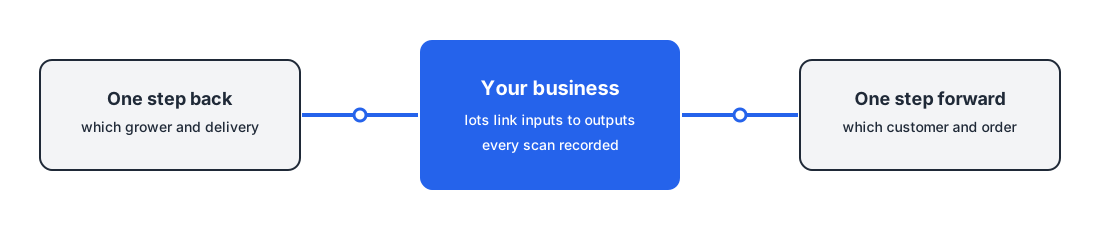
Traceability works by recording each movement of product and linking each step to the one before it and the one after it. The principle is often called "one step back, one step forward": each business in the chain knows where its product came from and where it went.
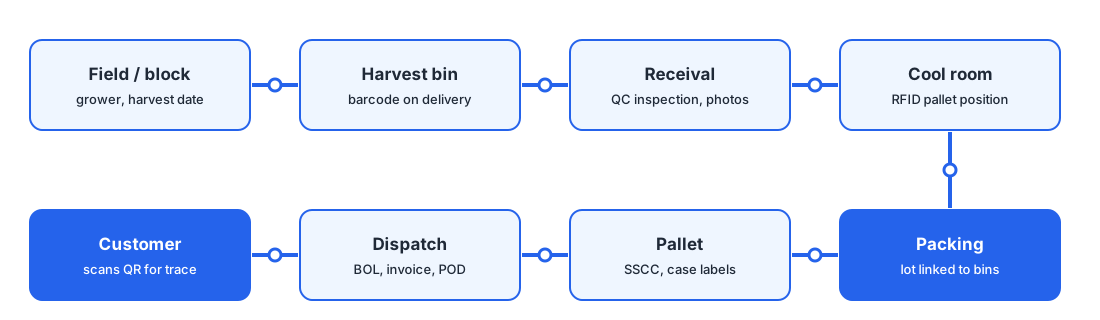
Inside a produce business, the chain has many links. Farmsoft's traceability material describes produce being barcoded on delivery to the packhouse and traceability labels applied at many levels throughout packing and value-adding. A typical chain looks like this:
Farmsoft's blog gives examples such as grapes tracked from vine, through wash, sort and packing, to sales and export to the customer, with similar end-to-end processes for strawberries, potatoes, leafy greens and fresh-cut produce.
What makes traceability "AI-powered"
Most of the heavy lifting in good traceability is done by automatic capture: barcode scans, RFID reads and lots created by the system. Producepak describes its traceability as automatic and built into the core of every process, action and document. Artificial intelligence adds three things on top.
AI that answers trace questions
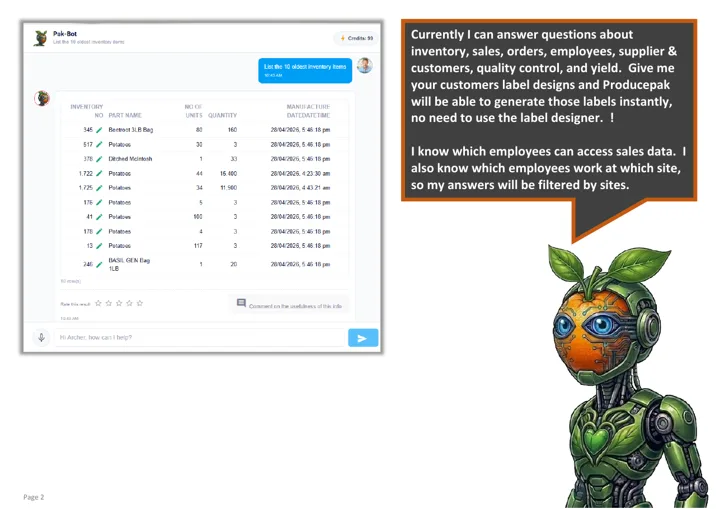
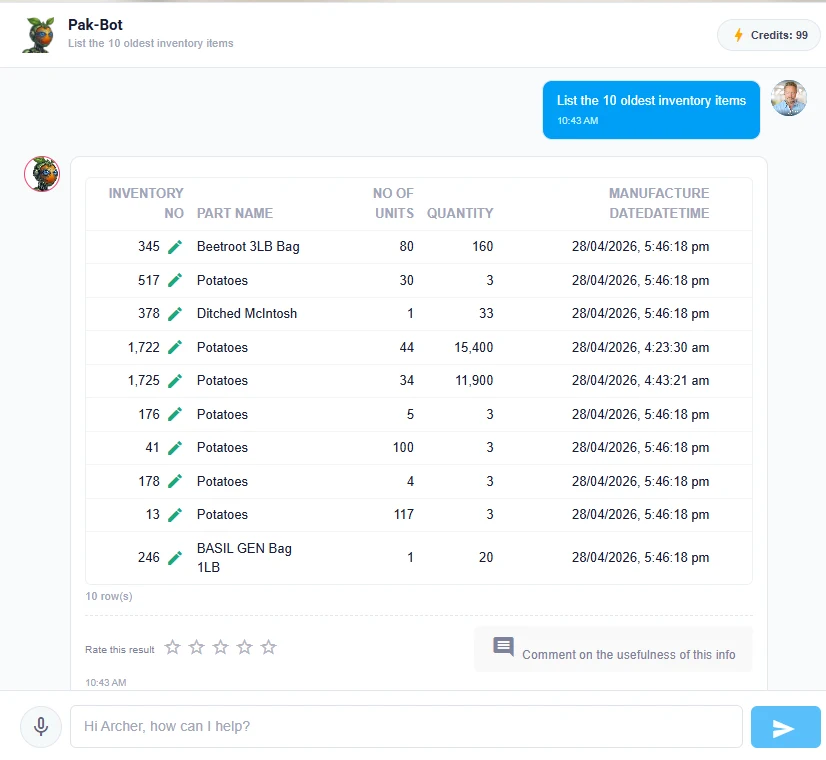
Pak-Bot, the AI chatbot built into Producepak, answers questions about inventory, sales, orders, employees, suppliers and customers, quality control and yield in plain language. During an investigation, people can ask what they need to know rather than running reports. The Pak-Bot guide shows questions such as List the 10 oldest inventory items, Totals of inventory owned by ACE Farming Group and Total of inventory at site Closters. The same approach applies to trace questions, such as which customers received a lot or how much of it remains in stock, depending on how your records are set up.
AI that reads documents
Pak-Bot converts customer documents into orders. When purchase orders are captured accurately from the start, the order, the pick, the pallet and the invoice all link correctly, which keeps the forward trace clean.
AI in quality inspection
Producepak QI uses Microsoft Azure image recognition, according to its app guide, and links inspections to deliveries and lots. Its guide describes tracing customer complaints back to the supplier or to the original crop, field or patch, and instant recalls. Quality evidence then becomes part of the traceability record.
AI with guardrails. Pak-Bot knows which employees can access which data and which site each employee works at. According to the Pak-Bot guide, your data, excluding prompts, is not sent to ChatGPT and stays on Producepak servers.
Five reasons to make traceability automatic
Each of the following has its own page on this site.
| Benefit | How Producepak delivers it |
|---|---|
| Reduce admin costs | Scans replace paperwork; documents, audits and trace reports are generated, not compiled. Farmsoft claims up to 90% lower waste, auditing and administration costs. |
| Improve accuracy | Barcodes at receival, packing and dispatch, RFID pallet positions and lots linked to source bins remove hand-written links. |
| Increase customer confidence | Accurate orders, proof of delivery, Chain-Trace QR codes and fast answers to buyer questions. |
| Reduce recall risk | Lot-level traceability narrows recalls; mock recalls and instant trace reports build readiness. |
| Ensure compliance | One set of records supports FSMA 204, PTI, GS1, HACCP, BRC, GlobalGAP, ISO and CanGAP. |
Traceability and the rest of Producepak
Traceability is not a separate module bolted onto Producepak; it is part of each one. The Producepak app guide lists features that all contribute to the trace:
- Inventory: barcode and RFID scanning, first-in first-out, stocktakes, multi-site warehouses and automatic auditing.
- Quality control: inspection templates, photos and video, supplier performance and corrective action alerts.
- Packing and production: batch scheduling, raw material calculation, waste tracking and automatic label generation.
- Orders and picking: guided pick slips and automatic bills of lading and invoices.
- Shipping and traceability: pallet tracking, proof of delivery, Chain-Trace QR codes and recall and audit documentation.
- Finance: links to Xero, QuickBooks, MYOB, Sage and SaasAnt.
Labels: where traceability becomes visible
A trace record is only useful if the product in someone's hand can be linked back to it. Labels make that link. Farmsoft's traceability labels article lists SSCC, EAN, GS1, UPC, PLU and voice pick codes for crates, cartons, totes, pallets, cases and shipping containers, with built-in PTI, Walmart, Woolworths, Coles, Aldi and Tesco formats. For more on labels, see the Fresh Produce Labels and AI site.
How to get started with AI traceability
- Watch the video. The Producepak product video shows the workflow end to end.
- Map your chain. List every point where product is received, moved, transformed and shipped.
- Decide what to scan. Bins, totes, cases and pallets; decide where barcodes and where RFID make sense.
- Set up labels. Choose built-in formats or design your own for each level.
- Run a mock recall. Pick a lot and trace it both ways; time how long it takes.
- Bring in Pak-Bot. Teach the team to ask trace questions directly.
Not ready to commit? Farmsoft offers a free food traceability app for labels, record keeping, recalls, mock recalls and audits, with no card required.
Traceability needs by business type
| Business | Biggest traceability challenge | Where automation helps most |
|---|---|---|
| Grower-packer | Linking fields and harvest dates to packed lots | Bin barcodes at harvest and receival; lots linked to bins |
| Packhouse packing for many growers | Keeping growers' product separate through grading and packing | Receival scans by grower; lot linking; ownership records |
| Fresh-cut processor | Many inputs mixed into each output | Transformation lots linked to every input lot |
| Wholesaler or distributor | Split pallets and mixed orders | Pallet and case scanning to orders; SSCC labels |
| Importer or exporter | Container-level records and documents across borders | Arrival inspections, lot records and export documents |
The cost of poor traceability
Poor traceability rarely shows up as a line in the accounts until something goes wrong. Then the costs arrive together: product recalled unnecessarily because the affected lots could not be isolated; days of staff time searching for records; retailer penalties or lost programs; certification findings; and damage to reputation with customers who expected better. Even without a recall, weak traceability costs money every day through administration, order errors and stock that cannot be found. Farmsoft's traceability material links better traceability to less waste and claims up to 90 percent lower waste, auditing and administration costs.
Common myths about traceability
"Traceability is only for large companies"
Regulations such as FSMA 204 and retailer requirements apply to businesses of many sizes. Farmsoft's free traceability app exists precisely so that small businesses can keep proper records.
"Paper records are good enough"
Paper can satisfy a basic one-step-back, one-step-forward rule on a quiet day. It struggles with the speed, detail and volume of modern produce operations, and it fails badly under the pressure of a real recall.
"Traceability slows the packing line down"
Scanning a barcode is faster than writing a record. RFID position tracking happens without any extra action by the forklift driver. Done well, traceability speeds operations up.
"AI will do it all for us"
AI helps people find and use traceability information. The records still have to be captured at each step, which is why automatic capture by barcode and RFID comes first.
Traceability terms in plain English
| Term | Meaning |
|---|---|
| Lot | A batch of product with a shared history, identified by a lot code |
| Traceability lot code (TLC) | The lot code used for FSMA 204 records, assigned at events such as initial packing |
| CTE and KDE | Critical tracking events, and the key data elements recorded at each one |
| SSCC | An 18-digit GS1 code that uniquely identifies a pallet or other logistic unit |
| PTI | The Produce Traceability Initiative case-labelling approach based on GS1 |
| Mock recall | A practice trace to test how quickly product can be traced back and forward |
| Chain-Trace | Farmsoft's QR-code traceability for buyers, on-chain or off-chain |
Traceability as a daily tool, not just an emergency plan
The best traceability systems are used every day, not only when something goes wrong. Sales staff check which lots are available and how old they are. Grower liaison staff check what each grower has in store. Quality staff check inspection results by lot. Dispatch confirms what is on each pallet. When traceability records are part of normal work, they stay accurate, and when a recall or audit does come, the team already knows how to find what it needs. Pak-Bot makes this everyday use easier, because anyone with the right access can ask a question instead of learning a report menu.
Ready to see it? The Producepak product video shows traceability, inventory, quality and Pak-Bot working together in a real produce workflow.
AI traceability questions
What is AI-powered traceability?
Automatic capture of every product movement by barcode and RFID, combined with AI that answers trace questions, reads customer documents into orders and links quality inspections to lots.
Who is Producepak traceability for?
Growers, packers, wholesalers, exporters, importers, distributors and food service businesses handling fresh produce.
Does Producepak support PTI and GS1?
Yes. Farmsoft's material lists PTI support and GS1, SSCC, EAN, UPC, PLU and voice pick labels.
Can I try traceability for free?
Farmsoft offers a free food traceability app for labels, records, recalls, mock recalls and audits.
Where can I see it working?
Watch the Producepak product video at producepak.com/Producepak.html#video02-9y.