Material on this page draws on the ProducepakQI app guide, the Producepak app guide, the Pak-Bot guide and Producepak and Farmsoft quality control pages listed under Resources below.
Quality control is where produce margins are won
Every fresh produce business makes its money in the gap between what it receives and what it sells. Quality decides the size of that gap. A load accepted without proper inspection can pack out poorly, get rejected by a retailer or end up in the waste bin. A supplier whose fruit slowly deteriorates over a season can cost far more than any price difference negotiated at the start. A retail program can be lost because of inconsistent product, even when most deliveries were good.
Despite this, quality control in many produce businesses still runs on clipboards, paper forms, phone photos sent by message and spreadsheets typed up at the end of the day. Inspectors work hard, but their findings arrive late, are hard to compare and rarely reach the people who need to act on them. AI-powered quality control changes that. It does not replace the inspector's judgement; it makes every inspection faster, more consistent and more useful to the rest of the business.
What AI-powered quality inspection means
"AI quality inspection" is used to describe many things, from camera systems on grading lines to chatbots that summarise reports. In Producepak, it means three connected capabilities working inside one quality inspection app.
Image recognition
According to the ProducepakQI app guide, Producepak QI uses Microsoft Azure image recognition AI and blob storage. Models are built from your own inspection photos and results, and management can tweak what a model returns and rebuild it.
Smart inspection programs
Unlimited inspection programs, four scoring methods, unlimited photos and documents per test, and reference images that show inspectors what each defect looks like.
AI answers and alerts
Automatic quality alerts with photos go to the right team members or suppliers, and Pak-Bot answers questions about quality control and yield in plain language.

The five outcomes that matter
Producepak describes the purpose of its quality inspection app in four phrases: reduce inspection costs, eliminate mistakes and waste, maximize quality and consistency, and make price negotiations easier. A fifth outcome ties them together: quality control integrated throughout the business. Each has its own page on this site.
| Outcome | How AI-powered inspection delivers it | Read more |
|---|---|---|
| Reduce inspection costs | Digital programs, no re-keying, automatic reports, AI suggestions that speed up each sample | Reduce inspection costs |
| Eliminate mistakes and waste | Reference images, value-range limits, alerts and inspections at every control point | Mistakes and waste |
| Make price negotiations easier | Photo evidence, measured defects and supplier history shared instantly | Price negotiations |
| Maximize quality and consistency | Standard programs, AI trained on your product, retailer specifications and trends | Quality and consistency |
| Integrate QC throughout the business | Links to every Producepak module, your finance app and other business apps | Integrated QC |
Key features of Producepak QI
The ProducepakQI app guide and Producepak's quality control pages list the following capabilities.
Unlimited inspection programs
The app can be configured with unlimited quality inspection programs and tests: one for each commodity, stage or customer specification. Farmsoft's quality control pages show programs for leafy greens, fresh-cut and salads, grapes, citrus, avocado, berries, mango, potato, onion, cucumber, broccoli and many more, along with food service and IQF products.
Four scoring methods
Each test can be scored the way that suits it: pass or fail, percent of sample, a score built by adding or deducting points, or a value range where the result must fall between set limits. See quality and consistency for how to choose.
Unlimited photos and documents
Inspectors can attach unlimited photos or documents to a test or criterion, and photos appear on inspection reports. Reference images and links to documentation can be shown during inspection so inspectors can compare what they see with the standard.
Flexible samples and data entry
An inspection can have one or more samples, and inspectors can add samples as needed. New records, such as a supplier name, can be entered at any time without predefining options.
Instant alerts
Each inspection program decides which team members, or suppliers, receive instant quality alerts, with photos and attachments included. Producepak's quality control app page describes these as corrective action alerts sent to the correct team members based on quality criteria.
Traceability and recalls
Customer complaints can be traced back to the supplier or to the original crop, field or patch, and recalls can be run quickly because inspection data is linked to lots.
Dashboards, labels and reports
The QI guide lists QC dashboards and QC labels, with user-designed labels printed directly from the app.
Integration
Producepak QI integrates with other Producepak modules, finance apps, hardware and equipment, with API integration available for custom features. See integrated QC.
Where to inspect
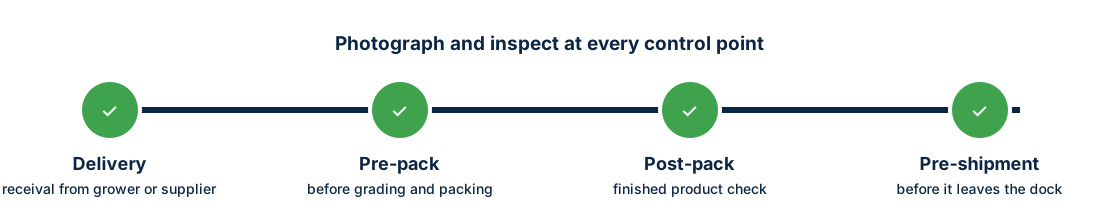
Farmsoft's quality control material describes recording photos of fresh produce at delivery, pre-pack, post-packing and pre-shipment. Those four control points form the backbone of a produce QC program.
What the AI does, and what it does not
Being clear about AI's role builds trust with inspectors and managers.
| AI helps by... | People remain responsible for... |
|---|---|
| Suggesting results from photos once a model is trained | Confirming or correcting every result |
| Applying scoring rules and limits consistently | Setting the standards and specifications |
| Sending alerts to the right people instantly | Deciding the corrective action |
| Answering questions about quality and yield through Pak-Bot | Commercial decisions with suppliers and customers |
The ProducepakQI guide is realistic about image recognition: it needs roughly five months of data gathering before a model is built, building can take hours to days depending on dataset size, and management can tweak the results and rebuild. In other words, the AI learns your product from your inspections. The benefits of digital inspection, alerts and integration arrive from day one; image recognition adds to them as your data grows.
Asking Pak-Bot about quality
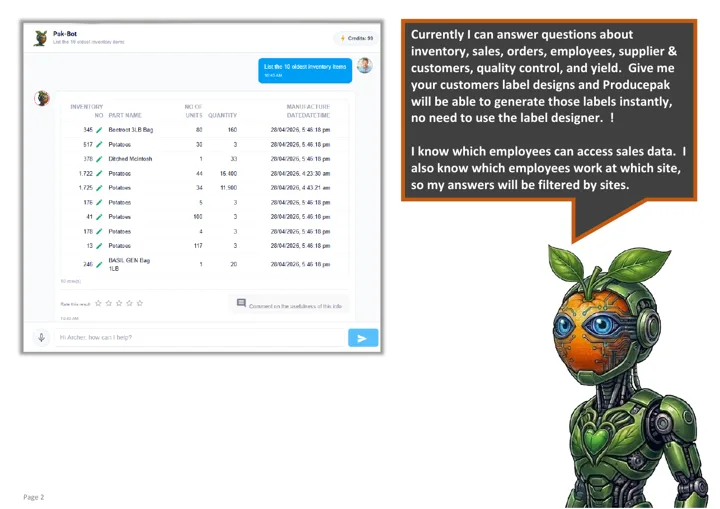
Pak-Bot, the AI chatbot built into Producepak, lists quality control and yield among the subjects it can answer questions about. Instead of building a report, a quality manager can ask in plain words, for example "rejected loads by supplier this month" or "average quality score by grower this season", and get a table or chart. Pak-Bot knows which employees can access which data and which site each employee works at, and the Pak-Bot guide states that your data, excluding prompts, is not sent to ChatGPT and stays on Producepak servers.
Who uses AI quality inspection
Producepak's quality control app is designed for growers, packers and wholesalers of all sizes. Farmsoft's quality pages also cover fresh-cut processors, food service suppliers, IQF producers and businesses handling meat and seafood. Typical users include:
- QA inspectors recording inspections on phones or tablets at receival and on the line;
- Quality managers setting up programs, reviewing alerts and analysing trends;
- Buyers and grower liaison staff sharing results with suppliers;
- Packing and dispatch managers acting on holds, regrades and pre-shipment checks;
- Owners and finance seeing how quality affects costs, claims and returns.
Built on HACCP thinking
Producepak's quality control app page describes its approach as based on the Hazard Analysis and Critical Control Point (HACCP) method of risk assessment and mitigation, covering microbiological, chemical and physical hazards. Inspection programs map naturally onto that thinking: identify where hazards and quality risks arise, set limits, check against them at control points, and act when a check fails.
Getting started
- Watch the Producepak video and book a demo.
- Read the ProducepakQI app guide for features and set-up details.
- List your control points and the commodities you inspect at each.
- Gather your current specifications, including retailer specifications, and defect reference photos.
- Build inspection programs, starting with your highest-volume or highest-risk product.
- Start capturing photos consistently, so image recognition models have data to learn from.
A day of AI-powered quality control
To see how the pieces fit, follow an illustrative day at a packhouse using Producepak QI.
| Time | What happens | Capability used |
|---|---|---|
| 05:30 | A grower's load is inspected at receival; decay is above the limit | Percent of sample scoring, photos |
| 05:40 | The buyer and the grower receive an alert with photos | Automatic alerts to team and suppliers |
| 08:00 | The lot is routed to a lower program after the grower agrees | Integration with inventory and packing |
| 10:15 | Post-pack check finds pack weights drifting low | Value range test, alert to line lead |
| 14:00 | Pre-shipment checks for a retail order pass, with photos stored | Retailer specification program |
| 17:00 | The quality manager asks Pak-Bot for rejected loads by supplier this week | Pak-Bot quality questions |
Nothing in this day relies on paper, re-keying or phone calls to pass on results. Every finding reaches the person who can act on it while the product still has value.
Questions to ask before you start
- Which products cause the most quality problems, claims or waste today?
- At which control points do you inspect now, and where are the gaps?
- Which customer specifications must you meet?
- Who needs to know about each kind of quality failure, and how quickly?
- Which other systems, such as your finance app, need quality information?
The answers shape your first inspection programs and alert rules, and they make the demo far more useful.
Commodities covered
Farmsoft's quality control pages present quality inspection apps for a wide range of products, which gives a sense of where AI-powered inspection is already applied in produce:
| Group | Examples |
|---|---|
| Leafy and fresh-cut | Leafy greens, fresh-cut, salads, coleslaw, spinach |
| Fruit | Grapes, citrus, avocado, strawberry, cherry, mango, berries |
| Vegetables | Potato, onion, cucumber, asparagus, garlic, carrot, broccoli, beans |
| Processed and other | Food service, IQF, meat, seafood, seeds, herbs |
Typical measurements across these products include visual checks for colour, brightness, wilting and discolouration; physical properties such as size and firmness; and chemical measurements such as sugar content on the Brix scale and pH.
Why integration is the fifth outcome
Cost, waste, negotiation and consistency improvements all depend on quality data reaching the rest of the business. An inspection that reduces waste only does so if the packing manager sees it; evidence only helps negotiations if the buyer has it; consistency only improves if suppliers receive feedback. That is why Producepak Quality Inspection is built to integrate with all other Producepak modules, your finance app and other apps in your business.
AI quality inspection questions
What AI does Producepak QI use?
According to the ProducepakQI app guide, it uses Microsoft Azure image recognition AI and blob storage, with models built from your own inspection data.
How long before image recognition is useful?
The QI guide states that roughly five months of data gathering is needed before a model is built, and building can take hours to days depending on dataset size.
How many inspection programs can I set up?
Unlimited. The app can be configured with unlimited quality inspection programs and tests.
Can suppliers receive inspection results?
Yes. Each inspection program can send instant alerts, including photos and attachments, to team members or suppliers.
Does quality inspection connect to the rest of Producepak?
Yes. Producepak Quality Inspection integrates with other Producepak modules, finance apps and other business apps.