
The question produce businesses are asking
Since general-purpose AI chatbots arrived, people across the produce industry have tried them at work. They draft emails to customers, summarise long specifications, explain regulations and suggest marketing copy. They are genuinely useful for that. Sooner or later, someone asks the obvious next question: can ChatGPT, or a similar tool, help run the business itself? Can it tell us our stock, our sales, our packout?
The short answer is no, not on its own. A general chatbot has never seen your cool room, your orders or your inspection records. It can only work with what you paste into it, and pasting operational data into a public tool raises problems of its own. This page explains the difference between a general chatbot and a produce-specific one like Pak-Bot, and where each belongs.
Side-by-side comparison
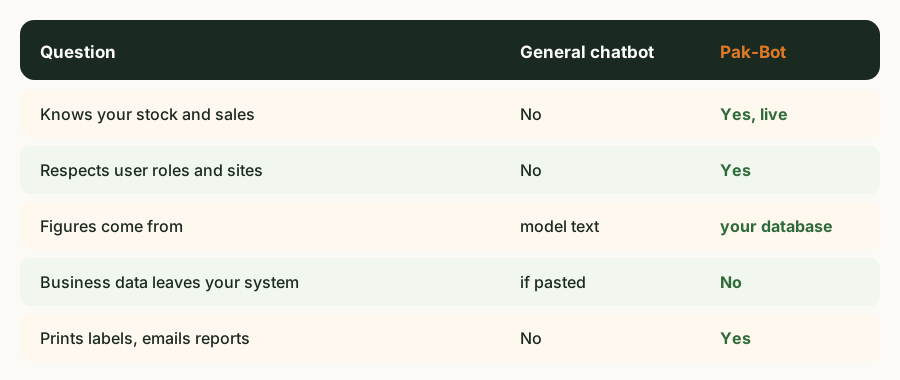
| Question | General chatbot | Pak-Bot in Producepak |
|---|---|---|
| Can it see my inventory? | Only if you paste or upload it | Yes, live from Producepak |
| Where do the numbers come from? | The model reading whatever you gave it | A query against your records |
| Does it know who is asking? | No | Yes: role and site assignments apply |
| Is my business data sent to an outside AI service? | Yes, if you paste it in | No; data, apart from prompt wording, stays on Producepak servers |
| Is the answer current? | Only as current as the file you pasted | Current at the moment of asking |
| Can it act? | Writes text | Emails results, prints documents and labels, prepares orders |
| Does it understand produce terms? | Generally | Generally, plus your own products, sites, customers and owners |
Problem 1: a general chatbot cannot see your operation
A general chatbot is trained on public text. It knows that Hass avocados are graded by count, that leafy greens are on the FDA Food Traceability List and that packout is a measure of yield. It does not know that you have 1,840 kg of yellow potato in store, that Woolworths ordered more baby spinach than you shipped in March, or that grower A's last three loads were downgraded.
To answer questions like those, a general chatbot needs the data handed to it, usually as a spreadsheet export. That brings back every problem exports have: they are out of date the moment they are saved, they are often filtered or edited by mistake, and different people end up working from different versions.
Pak-Bot is connected to Producepak, so the question Total yellow potato in stock is answered from the live inventory, not from an export.
Problem 2: numbers that are written, not counted
Large language models generate text. When you give one a table and ask for a total, it produces text that looks like a total. Often it is right. Sometimes, particularly with large tables, many similar rows or awkward units, it is wrong in ways that are hard to spot. AI researchers call confident but incorrect output "hallucination".
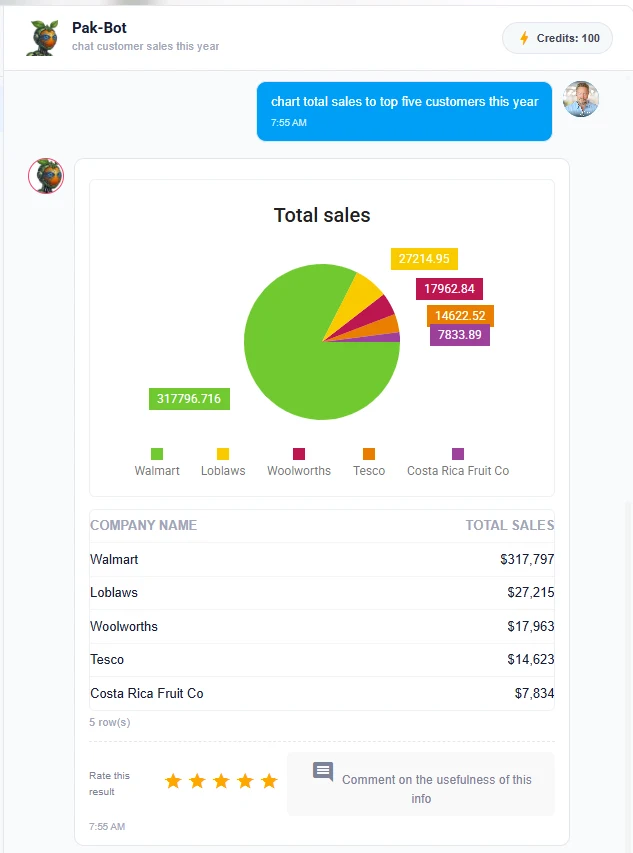
Pak-Bot uses the language model for what it is good at, understanding the question, and leaves the arithmetic to the database. When you ask for sales by state, Producepak calculates the sums. The figures in the answer are the result of a query, and the table under every chart lets you check them.
Problem 3: no idea who is asking
A general chatbot treats every user the same. If a packing floor employee pastes the customer price list into it, nothing stops them asking anything they like. Inside a business, that is not how information should work.
Pak-Bot knows which employees are allowed to see sales data and which sites each employee works at. Every answer is filtered by those rules before it is returned, and emails or printouts follow the same rules. Rephrasing the question does not unlock restricted data, because the restriction is applied to the data retrieved, not to the words used.
Problem 4: data leaving the building
Pasting commercial data into a public AI service means that data leaves your systems. Depending on the service and the settings, it may be stored, reviewed or used in ways you do not control. Customer pricing, grower settlements and retailer volumes are exactly the kind of information produce businesses guard carefully.
The Pak-Bot guide states that business data, excluding the wording of prompts, is not sent to ChatGPT and stays on Producepak servers. The model helps interpret the sentence you type; the records that answer it are read inside Producepak. Because prompt wording is used for interpretation, the sensible habit is to keep prompts free of confidential details such as passwords or bank information, which a well-formed question never needs anyway.
Problem 5: words, not actions
A general chatbot produces text. You still have to copy it somewhere, format it and send it. Pak-Bot is part of the system where the work happens, so it can do more than describe:
- Email Angela Coles sales from Q1 sends the result.
- Print the 10 oldest inventory items sends a list to the printer.
- Customer labels can be generated from loaded templates without opening a label designer.
- Customer purchase order documents can be turned into orders for staff to approve.
Where general chatbots still help
None of this means general AI tools have no place in a produce business. They are useful for work that does not depend on your operational data:
Writing
Drafting customer letters, product descriptions, job advertisements and marketing copy.
Explaining
Summarising regulations, standards and long documents in plain language, with the original as the authority.
Brainstorming
Ideas for new pack formats, promotions or process improvements.
Translating
Rough translations for multilingual teams, checked by a fluent speaker for anything important.
The dividing line is simple. If the answer depends on your stock, sales, orders, quality or growers, ask the chatbot connected to that data. If it depends on general knowledge or writing skill, a general tool may be enough, as long as no confidential data is pasted into it.
A practical policy for AI at work
Many produce businesses now need a short, clear policy on AI tools. A workable version fits on one page:
- Operational questions about stock, sales, orders, quality and growers go to Pak-Bot inside Producepak.
- Do not paste customer, grower, pricing, employee or financial data into public AI tools.
- General AI tools may be used for drafting and explaining, with the output checked by a person.
- Figures for financial statements and formal customer documents are confirmed against standard reports or the accounting system.
- Anything sent outside the business is reviewed by the sender before it goes.
The same question, two ways
Take a common request: "Which of our customers bought the most this year?"
With a general chatbot
Someone exports a year of invoices to a spreadsheet, removes columns that look sensitive, uploads or pastes the file, asks the question, receives a written answer, then checks it against the spreadsheet because they are not sure the totals are right. Elapsed time: twenty minutes to an hour, with commercial data now held by an outside service.
With Pak-Bot
Someone with sales access asks chart total sales to top five customers this year. The chart and table appear from live data. If needed, they ask Pak-Bot to email it to the general manager. Elapsed time: under a minute, with the data still inside Producepak.
What "connected" really means
Some general AI tools can now connect to files, drives or databases. That narrows the gap, but it does not close it. A connection gives a model access to data; it does not give it an understanding of how a produce business structures that data. Knowing that a "tote" is a container type, that inventory has an owner, that a site restricts what an employee may see, or that orders and invoices should be compared to calculate fill rate are all parts of the produce context Pak-Bot is built around.
Connecting a general tool also means configuring and maintaining permissions in a second place, keeping the connection secure and deciding what data the outside service may read. With Pak-Bot, those decisions are already made inside Producepak: the chatbot uses the same accounts, roles and site assignments as everything else.
Accuracy you can check
Every AI system makes mistakes sometimes. What matters is whether mistakes are visible and correctable. Pak-Bot is designed so they are:
- Tables beside charts let users check the figures behind every picture.
- Row counts show how many records an answer used.
- Ratings and comments on every reply flag misreadings to the Producepak team, who use them to train Pak-Bot.
- Database calculations mean totals are calculated, not written by the model.
When an answer looks wrong, the usual cause is a misread name or period. Rephrasing with the exact product, customer or site name and an explicit date range normally fixes it, and the comment helps prevent the same misreading for others.
Cost and effort compared
Building a produce-aware assistant on top of a general AI service is possible for a business with developers and time. It would need a connection to the operational database, a permissions layer, a way to calculate figures reliably, a way to send emails and print labels, and ongoing maintenance as the database changes. For most produce businesses, that is a software project they neither want nor need. Pak-Bot provides those pieces as part of Producepak.
| Component | Build it yourself on a general AI | Pak-Bot |
|---|---|---|
| Connection to operational data | Custom integration | Built in |
| Permissions by role and site | Custom layer to build and maintain | Uses Producepak settings |
| Reliable totals | Custom query generation and checks | Database queries |
| Email, print and labels | Separate integrations | Built in |
| Produce vocabulary | Prompt engineering and testing | Designed for produce, trained with user feedback |
Questions to ask any AI vendor
Whether you are looking at Pak-Bot or any other AI product for a produce business, these questions separate safe, useful tools from risky ones:
- Is my business data sent to an outside AI service to produce answers?
- Are figures calculated from my data or written by the model?
- Does the AI apply my existing user roles and site restrictions?
- Can users see the data behind a chart?
- Can users report wrong answers, and who acts on those reports?
- Do emails and printouts follow the same permissions as on-screen answers?
The bottom line
General chatbots are excellent writing and explaining tools. They are not operational systems, and they were never designed to be. A produce business needs answers that are current, calculated from its own records, limited to what each person is allowed to see and able to turn into action, such as an email, a printed list, a label or an order. That is the gap a produce-specific chatbot fills. Use general tools for general tasks, and use Pak-Bot for the questions only your own data can answer.
Explaining the difference to your team
Staff who already use general chatbots at home may wonder why the business asks them to use Pak-Bot for operational questions. A simple explanation works: general chatbots know about the world, Pak-Bot knows about our business. Ask a general chatbot how to store avocados; ask Pak-Bot how many avocados we have and how old they are.
Common questions about ChatGPT and Pak-Bot
Is Pak-Bot built on ChatGPT?
Pak-Bot uses a large language model to interpret questions. Business data, other than the wording of prompts, is not sent to ChatGPT and stays on Producepak servers.
Can I upload my Producepak export to ChatGPT instead?
You can, but the data leaves your systems, is out of date immediately, and the totals are produced by the model rather than calculated by a database. Pak-Bot avoids all three issues.
Does Pak-Bot make up numbers?
Figures come from queries against Producepak records, and charts are shown with their tables so they can be checked. Users can rate answers and comment if something looks wrong.
Can staff use general AI tools for other work?
That is a business decision. A common approach is to allow them for drafting and explaining, but never with confidential customer, grower, pricing or employee data.