
Guide · storage
Storage, curing and shrink: protect the crop you already paid for
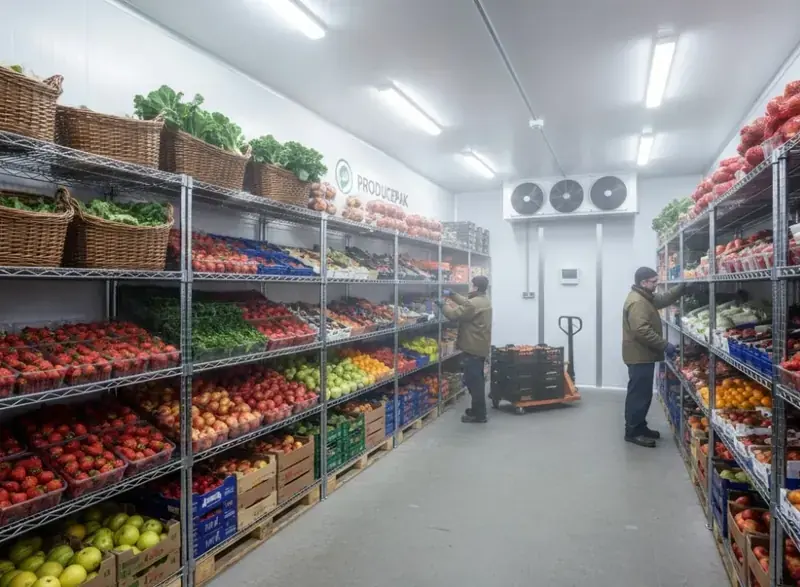
Every week in storage costs weight, and every wrong pull costs quality. This guide sets out the conditions each crop needs, where shrink comes from, and how Producepak turns every bay into a live, measured storage lot.
Watch the video & book a demo Full specifications (PDF)
US$6,200 a year · all modules · 8 users · unlimited sites
99% fewer shipping errors
95% less produce waste with precise inventory control
90% lower administration costs
Seconds to a chart or report from Pak-Bot AI
Storage conditions at a glance
| Crop / use | Curing | Holding temperature | Relative humidity | Typical storage life |
|---|---|---|---|---|
| Potatoes – table stock | 10–12.8 °C (50–55 °F), RH > 95%, at least 2 weeks; then cool ≤ 0.3 °C per day | 3.3–7.2 °C (38–45 °F) | High, without surface wetness | Months – variety dependent |
| Potatoes – French fry | As above | 7.2–10 °C (45–50 °F) | High, without surface wetness | Months – watch sugars |
| Potatoes – chipping | As above | 10–12.8 °C (50–55 °F) | High, without surface wetness | Months – watch sugars |
| Potatoes – seed | As above | 2.8–4.4 °C (37–40 °F) | High, without surface wetness | Until planting |
| Onions – pungent, dry | Field dry ~2 weeks, then forced air 25–27 °C (77–81 °F); 3–5% weight loss | 0 °C (32 °F) | 65–75% | 6–9 months |
| Onions – mild / sweet | As above | 0 °C (32 °F) | 65–75% | 1–3 months |
| Sweet potatoes | 27–29 °C (80–85 °F), RH 85–95%, 4–7 days (up to 10 if skinned) | 13–16 °C (55–60 °F); below 10–13 °C causes chilling injury | 85–90% | 3–6 months |
Sources: University of California IPM (potatoes), USDA ARS Handbook 66 (onions), Penn State Extension (sweet potatoes). Always follow your storage advisor and buyer specifications.
Where shrink comes from
- Water loss – the biggest share, driven by temperature, humidity and airflow
- Respiration – sugars burned while the crop is alive
- Rots and breakdown – one wet spot can take a bay
- Sprouting – warm or long storage, sprout control lapses
- Pressure bruising and handling damage at the bottom of piles and bins
- Unrecorded losses – culls dumped and never weighed
What Producepak measures
- Weight in per storage lot (grower, field, variety, harvest date, bay)
- Weight out per pull: packed, graded out, culled, sold as processing grade
- Shrink % = (weight in − weight out − weight on hand) ÷ weight in
- Temperature and humidity readings, curing start/end, sprout control applications
- QC samples per bay: rots, sprouting, pressure bruise, firmness, colour
- Days in storage and a "pack next" ranking by bay
Set up storage in Producepak – five steps
- Map the storage Each cellar, bay, pile or room becomes a Producepak location with capacity in bins or tonnes.
- Receive by storage lot Bins or truckloads are weighed in with grower, field, variety, harvest date and destination bay.
- Record the conditions Curing dates, temperatures, humidity and treatments against the bay – by hand, by import or by sensor feed.
- Sample on a schedule QC checks per bay with photos; scores trend over time.
- Pull to plan Pack the bays that will not keep first. Every pull is weighed out, so shrink is calculated automatically.
Ask Pak-Bot about storage
You: “Show shrink % by storage bay this season as a chart.”
You: “Which onion bays have rot over 2% in the last two samples?”
You: “How many weeks of Russet supply do we have at current pack rates?”
Answers come from the live storage records, in seconds, as a table or chart you can send to the grower or the sales team.
Questions
Can Producepak read our storage sensors?
Readings can be imported or entered against each bay. Ask in the demo about your sensor system.
Do you track grower shrink separately?
Yes. Shrink is calculated per storage lot, so it can be reported per grower, field, variety or bay and used in grower settlements.
More guides for potato, onion and sweet potato businesses
- Grading, packout & grower pay Packout % by grower lot, grades, culls and settlements that add up.
- Bagging, labels & shipping Bag weights, bilingual Canadian labels, PTI cases and loads that are right.
- FSMA 204 & SFCR compliance What the US and Canadian rules really require for these three crops.
- Processing & fresh-cut Peeled, diced and fresh-cut: yields, lot codes and by-products.
- AI reports & Pak-Bot Ask for a shrink chart, run the line by voice, print from anywhere.
- All potato, onion & sweet potato guides Start here.
See Producepak running on your product
Watch the short video, then book a live demonstration with a fresh produce consultant who knows US packhouses, PTI labels and FSMA 204.