Woolworths Coles IGA fresh produce compliance
Woolworths Coles IGA fresh produce compliance is made easy using Farmsofts Fresh Produce Packing App. From inventory, quality inspection, packing, through to accurate shipping - Farmsoft complies with all Woolworths Coles IGA fresh requirements.
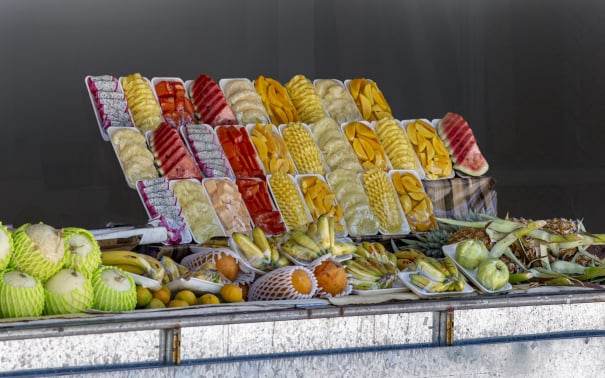
Woolworths fresh produce compliance and requirements
View Fresh Produce App Specifications and Requirements.
If you’re a grower looking to supply Woolworths Group with your fresh produce, the rules can be overwhelming. So how can you ensure your products are accepted into DCs without any headaches?
Woolworths Group calls itself the “The Fresh Food People” for good reason. The company has strict standards for its fresh produce suppliers, ensuring its customers can buy the freshest and safest produce possible.
Knowing the rules:
Woolworths launched its produce delivery requirements in 2021, with the aim to enhance the quality and safety of produce items it receives from suppliers.
The biggest focus is on two areas:
1. Carton and crate labelling
2. Pallet-wrapping requirements
Carton and crate labelling for fruit & vegetables
For many fruit and vegetable suppliers, carton and crate labelling is a brand-new space that you may never have considered.
1. GTIN barcode placement
Woolworths Group heavily relies on the GTIN barcoding of trade units (cartons/crates) to identify products through the supply chain and in-store back-of-house processes.
The placement of carton GTIN barcodes is essential to ensure that team members can quickly identify stock at first glance and don’t have to waste time trying to locate a barcode.
The rules around how and where GTIN barcodes must be applied depend on the type of carton or crate you are using:
Cardboard cartons using print-and-apply labels: GTIN barcodes must be on at least two vertical sides, preferably adjacent.
Pre-printed cardboard cartons (where the barcodes are embedded into the artwork and pre-printed onto the flat carton): GTIN barcodes are required on at least four vertical sides of the trade unit.
Returnable plastic crates: at least one produce crate label must be placed within the prongs on the forklift-entry side of the pallet.
2. Information required on fruit & vegetable crate and carton labels
In addition to the GTIN barcode, Woolworths Group requires additional information to be printed on the crate or carton label to ensure the team members can quickly identify the contents throughout the supply chain networks and in stores.
While not all fields are relevant to every category, required information can include:
Product description and variety
Country of origin
Date packed
Date of despatch
Best-before date
Harvest date
Batch number
Vendor name and full address
Grower name and full address
Packer name and full address
Check Woolworths’ requirements for details of what’s needed on your produce carton labels.
Pro Tip: When applying the label on the carton, make sure the prongs don’t obscure the information and cause a non-conformance issue.
3. Identifying temperature-controlled produce
Some produce, such as chestnuts, cherries, strawberries and apples, must be temperature-controlled throughout the supply chain.
To make it easy for team members to identify this and ensure food safety, these products must have a crate/carton label printed on pink paper.
For consistency, Woolworths is particular about the shade of pink, too: it must be Pantone Pink #182C.
Pallet wrapping for fruit & vegetables
Pallet wrapping is crucial for fresh produce suppliers looking to supply to Woolworths Group.
Here’s a breakdown of the pallet wrapping requirements:
Stretch wrap should be applied with adequate tension and passes to ensure it secures the load.
Stretch wrap must cover the top 30-50% of the wooden pallet to anchor the product and ensure pallet security.
Loose or trailing ends of stretch wrap are not permitted – all wrap ends must be secured.
Opaque or black stretch wrapping is not allowed – it must be a clear wrap.
Stretch wrap should not be excessively tight, causing packaging deformation, breaking product perforations or damaging products.
Nylon or string netting is not permitted as it poses a trip hazard to team members and causes issues with identifying stock and readability.
Pallet wrapping techniques for ventilation
Fresh produce isn’t like other products, as many fruits and vegetables must be kept cool throughout the supply chain. Ventilation is essential to reduce humidity, prevent mould formation, and prolong the shelf life during transit and storage.
Woolworths allows specific pallet-wrapping techniques for fresh produce to allow for maximum airflow without compromising the pallet’s stability and safety:
1. Butterfly-wrapping techniques
This preferred method can be used with standard pallet stretch film to allow maximum airflow while ensuring the pallet remains stable as it moves through the supply chain network.
Requirements when using the butterfly wrapping technique:
Every two layers of stock should be secured with wrap.
The top layer of the pallet must be secured with wrap.
Image: Butterfly stretch-wrapping technique
2. Low-adhesion stretch tape and wrapping combination
You can use low-adhesion stretch tape to hold palletised goods during transport and storage and some stretch wrapping to secure the stock.
If you use low-adhesion stretch tape, you must:
Only use heavy-duty, slow-adhesion stretch tape. Sticky tape or masking tape is not permitted.
Apply the stretch wrap to secure at least the bottom layer of stock, ensuring it’s safe for transport and that there’s no risk of the stock falling from heights.
Image: Low-adhesion stretch tape and wrapping combination
Making compliant labelling easy for fresh produce
Don’t let labelling become a compliance issue. Matthews offers a cloud-based printing tool to remove the stress of supermarket labelling compliance for fresh produce suppliers.
Coles fresh produce compliance and requirements
Fresh produce quality inspection specifications & requirements.
Audit Requirements for all Fresh Produce Suppliers
This article contains the Coles requirements that all suppliers of fresh produce must comply with. It is the suppliers' responsibility to communicate the Coles Brands standards through their supply chain to ensure compliance.
Audits
Coles currently operates certification schemes against a number of different standards:
Part 1 – Third Party Audits & Certification
Coles Brand Suppliers (Food) must be certified by an approved GFSI 3rd party certification eg: BRC, SQF, Freshcare.
An up-to-date certificate must also be uploaded to Coles Fusion annually.
All Coles farming suppliers of fresh bananas (including proprietary fresh bananas) must be certified at a minimum to one of the following environmental farming standards:
Freshcare Environmental or
ISO140001:2015
Coles Brand Suppliers may have a choice of external standard. The matrix below may assist in making a choice of preferred 3rd Party Standard. Use the
HRPS decision Graphic for Produce Suppliers
to select the appropriate standard.
Suppliers of fresh produce who are located in Australia and New Zealand must ensure that they are using a Coles approved Certification Body and that the auditor is certified under the Coles Auditor Scheme.
Part 2: Coles’ Additional Requirements of supply
In addition to the audit against the external standard, Coles Brand produce suppliers must ensure that they are compliant to the additional elements of the
‘HARPS’ (Horticulture Australia Retailer Produce Standard)
, Coles additional program requirements are that suppliers must comply with Part 1 (above), plus the
‘HARPS’ (Horticulture Australia Retailer Produce Standard)
. Please note the Coles Supplier Requirements (CSR) no longer apply.
IGA Metcash fresh produce compliance and requirements
Metcash-owned supermarket chain IGA honoured its independent retail owners this week at the IGA Awards of Excellence with 14 stores recognised across 22 categories.
Fresh St. Market IGA in Queensland claimed the awards for National Retailer of the Year, SUPA IGA of the Year, SUPA IGA Grocery & GM Department of the Year and SUPA IGA Fresh Produce Department of the Year.
The store was described as a “complete shopping destination”, praised for its “huge range” of grocery and fresh products including health foods, bulk foods and products for allergy sufferers, with as many products as possible sourced locally.
“We are passionate about supporting local producers, farmers and smaller companies and whether you want to grind your own coffee, make your own nut butter, buy in bulk or just do your everyday grocery shop, we will look after you,” store owner Michael Shakes said.
Rather than moving toward self-serve checkouts like many of the bigger retailers are opting to do, Shakes instead employs friendly locals to deliver a top customer experience.
The store also switched to recyclable packaging and energy efficient refrigeration in an effort to reduce its carbon footprint and better serve a more eco-conscious consumer base.
The national awards were held on the Gold Coast on Monday, with stores judged on a range of criteria including customer service, community pride, department excellence, brand values, sales, profits, merchandising and overall performance.
Preston Street IGA, Como, WA
Preston Street IGA in Como, Western Australia, was awarded IGA Store of the Year as well as IGA Bakery Department of the Year and IGA Fresh Produce Department of the Year.
The store was described as a “market leader” with the highest quality fresh produce, exceptional meal solutions prepared by experienced chefs and a bakery and meat offer that have “set the benchmark” within the industry.
“IGA Preston Street is a great example of the level of excellence that can be achieved by a small size store. The entire team are strong supporters of the local community, donating to numerous charities and supporting many schools and sporting organisations. All this together with old school customer service makes IGA Preston Street the complete package,” the association said.
Loveys IGA Xpress Hawks Nest took home the IGA Xpress Store of the Year award for its well planned store, large range of slice-on demand meats, specialty cheese and fresh options.
Its high quality fresh produce is provided by the Co-op direct from the markets of Sydney and Newcastle.