Where traceability admin costs come from
Traceability is often thought of as a compliance cost: something the business has to do, at the expense of time that could be spent elsewhere. In a manual system, that view is accurate. Every delivery needs a handwritten record. Every lot needs a run sheet. Every pallet needs its contents copied onto a dispatch document. Every audit needs folders pulled from a cabinet and cross-checked. Every trace request from a customer means someone spending an afternoon with paper and spreadsheets.
None of that work makes product better or customers happier. It exists only because the information was not captured in a form that could be retrieved easily. Remove the manual capture and the manual retrieval, and most of the admin cost disappears. Farmsoft's traceability material states that its software can reduce fresh produce waste, auditing and administration costs by 90 percent.
The hidden admin of manual traceability
- writing grower, block, weight and date details at receival;
- labelling bins and pallets by hand;
- recording which bins went into which packing run;
- copying lot numbers onto dispatch documents;
- typing paper records into spreadsheets;
- preparing for audits and mock recalls;
- answering customer and regulator trace requests;
- correcting errors when records do not match.
Automatic capture instead of paperwork
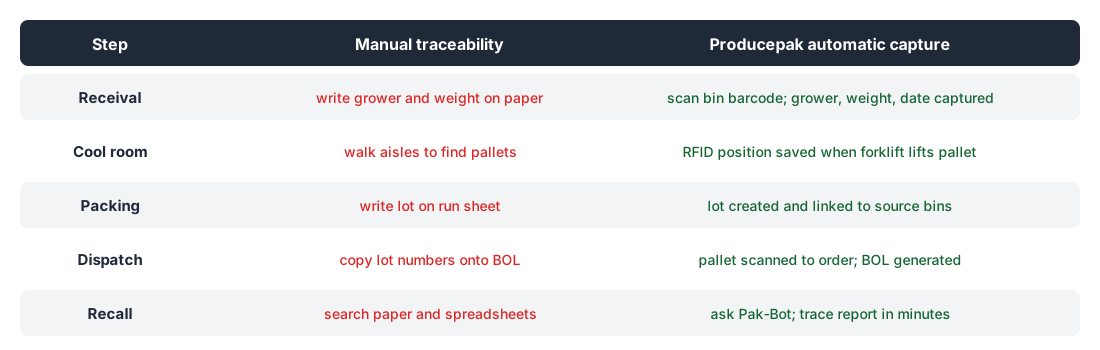
Producepak builds traceability into each process rather than adding it afterwards. Farmsoft's description is that traceability is built into the core of every process, action and document.
Receival
Produce is barcoded on delivery to the packhouse. Grower, product, quantity and date are captured with the scan, not written down. Farmsoft's traceability app material describes automatic capture of traceability data from incoming deliveries through barcode scanning, saving time and increasing accuracy.
Storage
Where RFID is used, pallet positions are saved automatically when a forklift lifts a pallet. No one walks the aisles with a clipboard. See improve accuracy for how it works.
Packing
Lots are created in the system and linked to the bins and deliveries that went into them. Labels print from the lot record.
Dispatch
Pallets are scanned onto orders. Bills of lading and invoices are generated automatically, as listed in the Producepak app guide, with the lots already attached.
Documents that produce themselves
Much traceability admin is document preparation. In Producepak, documents are by-products of the workflow:
| Document | Manual effort | In Producepak |
|---|---|---|
| Receival record | Handwritten, then typed | Created by the receival scan |
| Traceability labels | Hand-labelled or edited per run | Printed from the lot record |
| Pick slip | Prepared from orders | Guided pick slips generated |
| Bill of lading | Copied from pallet records | Generated automatically |
| Invoice | Typed from dispatch notes | Generated and sent to the finance app |
| Proof of delivery | Paper signatures filed | Recorded against the order |
| Recall and audit reports | Compiled from folders | Produced from linked records |
Audits without the scramble
Audits are where manual traceability costs are most visible. Before a certification audit or retailer visit, staff spend days finding records, checking that they agree and filling gaps. Farmsoft describes recalls, audits, mock audits and quality assurance compliance made easy and inexpensive, and the Producepak traceability app page highlights instant audits and recalls. When records are captured automatically and linked, the auditor's sample trace can be answered on the spot.
Practical test: ask how long your last audit trace exercise took, including preparation. That figure is the baseline against which to measure automated traceability.
AI that answers instead of staff who search
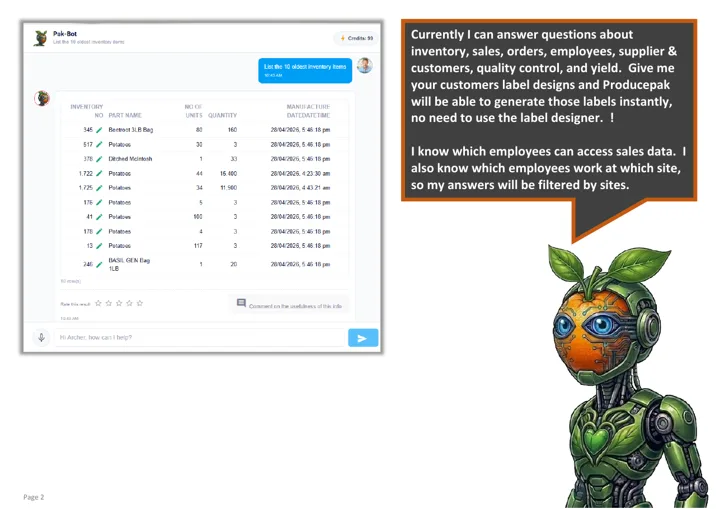
A large share of traceability admin is answering questions: from customers, auditors, managers, growers and regulators. Pak-Bot answers questions about inventory, orders, suppliers and customers, quality control and yield in plain language. Instead of an administrator searching records, the person who needs the answer can ask. The Pak-Bot guide includes examples such as Totals of inventory owned by ACE Farming Group and Total of inventory at site Closters. Pak-Bot can also email and print documents and reports on request, so the answer can be sent straight to the person asking.
Pak-Bot respects permissions. It knows which employees can see sales data and which sites each employee works at, so self-service answers do not expose information to the wrong people.
Order entry: keeping traceability clean from the start
Traceability errors often start with orders. A wrongly keyed order leads to the wrong product on the truck, a returned pallet and a broken forward trace. Pak-Bot converts customer documents into orders, reading purchase orders so staff check and confirm rather than retype. Fewer keying errors means fewer corrections to traceability records later, which is admin time saved twice.
Costs you can measure
To see the effect on admin, measure a few things before and after:
- hours per week spent writing, typing and filing traceability records;
- hours spent preparing for each audit;
- time taken to complete a mock recall;
- time taken to answer a customer trace request;
- number of record errors found during audits.
Farmsoft claims up to 90 percent lower waste, auditing and administration costs; your own before-and-after measurements will show the real figure for your business.
Starting small: the free option
Businesses that want to reduce traceability paperwork without a large commitment can start with Farmsoft's free food traceability app, which offers traceability labels in EAN, GS1, PTI, voice pick, SSCC, PLU and UPC formats and Walmart, Tesco, Woolworths and Coles formats, along with record keeping, recalls, mock recalls and audits. No card is required for the free version.
A week of traceability admin, before and after
The table below shows how traceability admin typically shifts when records are captured automatically. The tasks are typical; measure your own hours to see the real difference.
| Task | Manual approach | Automatic approach |
|---|---|---|
| Receival records | Written at the dock, typed later | Captured by the receival scan |
| Stock location records | Updated by walking the cool room | Updated by RFID reads or location scans |
| Packing run records | Run sheets collected and filed | Lots created and linked in the system |
| Dispatch paperwork | Lots copied onto documents | Documents generated with lots attached |
| Customer trace requests | Hours of searching | Minutes, with Pak-Bot answering questions |
| Weekly stock reconciliation | Spreadsheet comparison | Live inventory; quick checks with Pak-Bot |
| Audit preparation | Days of collecting folders | Records already linked and searchable |
Admin savings by role
Receival staff
Scan instead of write. The time saved at the dock goes into inspecting product properly.
Office and administration
No more typing up paper records or copying lot numbers between documents. Invoices flow to the finance app instead of being keyed twice. Producepak connects to Xero, QuickBooks, MYOB, Sage and SaasAnt, according to its app guide.
Quality and compliance staff
Audit and mock recall preparation shrinks from days to hours, because records are complete and linked.
Managers
Answers to trace and stock questions come from Pak-Bot or live screens rather than from asking someone to compile a report.
Grower and supplier paperwork
Businesses that pack or sell for growers carry extra traceability admin: records of each grower's deliveries, ownership of stock in store, packout by lot and settlement statements. Producepak records inventory ownership, so questions such as Totals of inventory owned by ACE Farming Group can be answered directly. Producepak also reports a 90 percent reduction in grower payment administration costs. When traceability records and grower records are the same records, grower queries take minutes rather than hours.
Multi-site businesses
Admin multiplies when a business runs several packhouses, cool stores or warehouses, each with its own paperwork. The Producepak app guide lists multi-site warehouses among its inventory features. With every site capturing records in the same system, head office sees the whole picture without collecting files from each location, and transfers between sites are traced like any other movement.
Hidden costs of correcting errors
Manual traceability has a second admin cost that is easy to miss: fixing mistakes. A grower code written wrongly at receival has to be found and corrected later, often after it has flowed into packing records, grower statements and invoices. A pallet shipped without being recorded leaves a gap that someone must reconstruct from memory and delivery dockets. Each correction takes far longer than recording the information correctly in the first place. Automatic capture removes most of these errors at source, so the admin team spends its time on exceptions rather than on cleaning up records.
Integration with finance avoids double entry
In many produce businesses, the same information is entered twice: once in the operational records and again in the accounting system. Every second entry is admin cost and a chance for the two to disagree. Producepak generates invoices from dispatch records and connects to finance apps including Xero, QuickBooks, MYOB, Sage and SaasAnt, according to its app guide. The trace record, the invoice and the accounts all describe the same shipment, entered once.
Where to start reducing admin
- Measure where traceability admin time goes today.
- Automate receival first; it is where most records begin.
- Add packing lots and labels printed from records.
- Scan pallets onto orders at dispatch.
- Connect invoices to your finance app.
- Teach managers to ask Pak-Bot instead of requesting reports.
Each step removes a layer of paperwork, and the savings fund the next.
Admin savings that compound
Admin savings from automatic traceability grow over time. In the first months, the obvious paperwork disappears. Later, fewer errors mean fewer corrections, audits become routine, and staff who once spent their days on records move to work that adds value, such as supplier development, customer service or quality improvement. The business can grow without adding administration in proportion.
Questions to ask about your current admin
- How many times is the same lot number written or typed between receival and invoice?
- How long does it take to answer a customer's trace request today?
- How many days does audit preparation take?
- How often are records corrected after the fact?
- Who in the business spends most of their week on traceability paperwork?
The answers point to where automation will save the most, and give a baseline for measuring results after Producepak is in place.
Admin cost questions
How much can automatic traceability save?
Farmsoft's traceability material claims up to 90 percent lower fresh produce waste, auditing and administration costs. Measure your own baseline to see your result.
Which documents are generated automatically?
The Producepak app guide lists guided pick slips, bills of lading, invoices, proof of delivery and recall and audit documentation, with labels generated during packing.
How does AI reduce admin?
Pak-Bot answers trace, inventory and order questions directly, emails and prints results, and converts customer documents into orders.
Is there a free version?
Yes. Farmsoft's free food traceability app covers labels, records, recalls, mock recalls and audits, with no card required.