What customers expect from produce suppliers
Retailers, food service operators, wholesalers and importers buy more than fruit and vegetables. They buy reliability: the right product, in the right quantity, at the right quality, labelled correctly, delivered on time, with answers available when questions arise. Traceability underpins every one of those expectations. Farmsoft's traceability material puts it directly: increased traceability results in improved customer confidence in product quality.
Customer confidence is built in ordinary moments, not only in crises. A delivery that matches the order exactly. A pallet label that scans first time. A quick answer to "which farm did this come from?". A quality complaint handled with photos and facts. Each one tells the customer that the supplier knows what it is doing. Each failure tells them the opposite.
Five ways traceability builds confidence
Accurate orders
Pallets scanned onto orders mean customers receive what they ordered. Farmsoft claims 100 percent order picking accuracy.
Compliant labels
Built-in PTI, GS1, SSCC and retailer formats, printed from the record.
Proof of delivery
Delivery recorded against each order, listed in the Producepak app guide.
Fast answers
Trace questions answered in minutes, with Pak-Bot helping staff find the facts.
Transparency
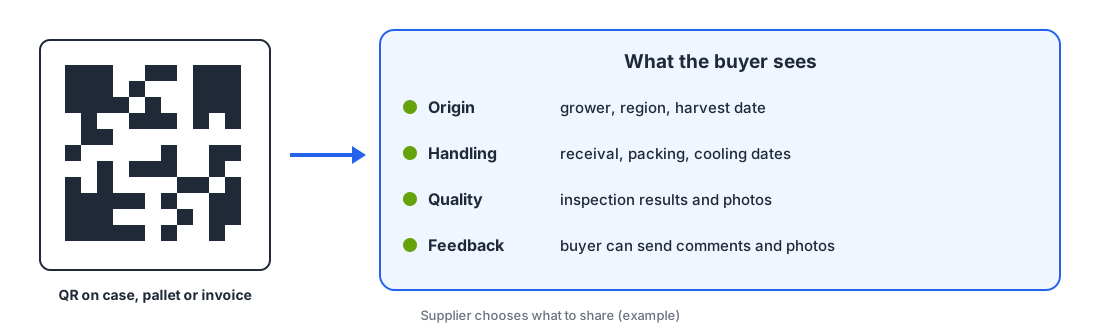
Chain-Trace QR codes let buyers see the supply chain information you choose to share.
Chain-Trace: letting buyers see the story
Farmsoft's blockchain traceability material describes Chain-Trace, a low-cost traceability solution for growers, packers, wholesalers and importers and exporters. Barcodes or QR codes are applied at points in the supply chain, such as the invoice, bill of lading, pallet, case or consumer unit. Purchasers scan them to see the supply chain traceability information the supplier has chosen to share, and can send feedback and photos.
On-chain and off-chain options
Farmsoft describes two models. On-chain, traceability packages are uploaded to a node on a blockchain, creating a permanent, verifiable record. Off-chain, the supplier's traceability information is stored in a vendor's database without using a blockchain. Many produce businesses start off-chain, which gives buyers the same scan-to-see experience at lower complexity, and move on-chain where a customer or program requires it.
Why blockchain attracts attention
Farmsoft's article cites a well-known retail pilot in which tracing the origin of mangoes went from about seven days to about 2.2 seconds. The broader lesson applies to any digital traceability: when records are captured at each hand-off and linked electronically, questions that once took days take seconds. Farmsoft also notes that all parties in a chain must adopt the technology for it to work fully.
Answering buyer questions quickly
Buyers ask suppliers questions all the time: which grower supplied a delivery, when it was packed, what the pre-shipment inspection showed, whether a particular lot went to other stores. A supplier who answers within minutes looks professional and in control; one who needs two days looks the opposite.
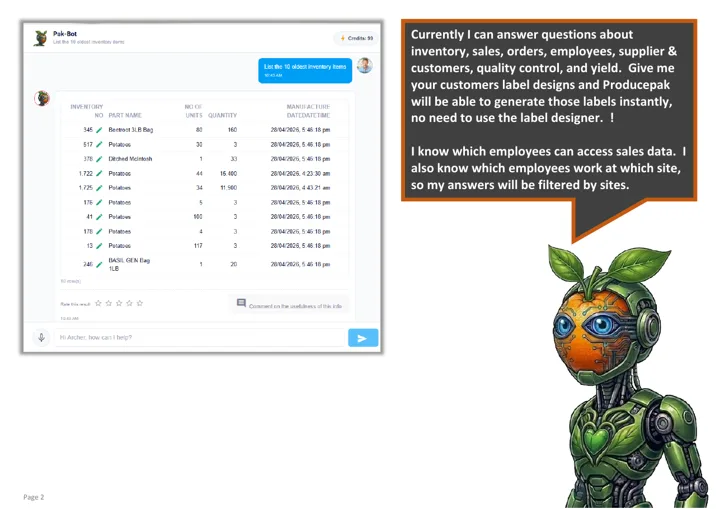
Pak-Bot answers questions about inventory, orders, suppliers and customers, quality control and yield. Staff can ask in plain language and email the answer straight to the buyer after checking it. Example questions from the Pak-Bot guide include Walmart orders vs sales Q1 2026, which compares what a customer ordered with what was shipped, a useful check before any supplier review.
Quality evidence that customers trust
Quality and traceability go together in the customer's mind. When a complaint arrives, a supplier who can show the pre-shipment inspection for that lot, with photos and measurements, and trace the product back to the grower and receival inspection, earns trust even when something has gone wrong. The ProducepakQI guide describes tracing customer complaints back to the supplier or to the original crop, field or patch, and photos showing on inspection reports. See the Quality Inspection AI site for more.
Customer satisfaction measures to watch
| Measure | Why it matters | How traceability helps |
|---|---|---|
| Orders delivered complete and correct | The most basic expectation | Scanned picking and dispatch |
| Deliveries accepted at the dock | Rejections cost both parties | Compliant, scannable labels; pre-shipment checks |
| Time to answer a trace request | Shows control and professionalism | Linked records and Pak-Bot questions |
| Complaints resolved with evidence | Turns disputes into fixes | Lot-linked inspections and photos |
| Supplier scorecard results | Determines future volume | All of the above |
Confidence for growers, too
Growers who supply packers and marketers are customers of a different kind. They want to know where their product is, how it packed and what it sold for. Producepak records inventory ownership, so questions such as Totals of inventory owned by ACE Farming Group can be answered directly, and results emailed to the grower. Transparent traceability builds grower loyalty in the same way it builds customer loyalty.
Supplier scorecards
Many retailers and large food service customers rate their suppliers on scorecards covering on-time delivery, fill rate, label compliance, quality and responsiveness. Traceability touches every line. Scanned picking improves fill rate accuracy. Labels printed from records improve label compliance. Linked inspections support quality scores. Fast answers improve responsiveness. Reviewing scorecards monthly, alongside your own records, shows where traceability improvements will lift your rating.
Handling a customer complaint step by step
- Record the complaint against the customer, order and, if possible, the lot code from the label.
- Trace back from the lot to the packing record, receival, grower and inspection results.
- Check the pre-shipment inspection for that order, with photos.
- Check other customers who received the same lot, in case the issue is wider.
- Respond with facts: what you found, what you are doing and when.
- Fix the cause with the grower, the packing process or the transport provider.
A complaint handled this way often strengthens the relationship, because the customer sees a supplier in control of its supply chain.
Customer portals
The Producepak app guide lists customer portals with a B2B and B2C shopping cart, order management, quality feedback and invoice access. Portals let customers see their own orders and invoices and send quality feedback without phone calls and emails, which adds another layer of transparency. Combined with Chain-Trace codes on products and documents, customers can find the information they need when they need it.
Food service and export customers
Food service
Restaurants, caterers and institutions often order daily and need consistent product with clear use-by information. They value suppliers who deliver exactly what was ordered and can answer allergen, origin and handling questions quickly.
Export customers
Importers abroad need accurate documents, consistent labelling and confidence that product was handled correctly before shipment. Traceability records, pre-shipment inspections and export documents from the same system give them that confidence and support any claims process if something goes wrong in transit.
Turning traceability into a sales tool
Traceability is often treated as a cost of doing business, but it is also a selling point. Showing a prospective customer a live trace from field to dispatch, or a Chain-Trace QR code that reveals the grower and handling story, differentiates a supplier from competitors who cannot. Many buyers now ask about traceability early in supplier selection; having a confident, demonstrable answer helps win business as well as keep it.
Confidence through consistency
Customer confidence is cumulative. A buyer who receives accurate orders, correctly labelled pallets and prompt answers week after week comes to trust a supplier, and that trust carries the relationship through the occasional problem. The opposite is also true: a run of small errors erodes confidence even if each is minor. Automatic traceability helps by making accuracy the default rather than the result of extra effort. When the system records what actually happened, the documents, labels and answers customers receive are consistent with each other and with the product on the pallet.
Confidence for consumers
End consumers increasingly want to know where their food comes from. Retailers respond with origin labelling, farm stories and, in some cases, QR codes that link to product information. Chain-Trace codes on consumer units, as described in Farmsoft's blockchain article, are one way for a supplier to support that demand. The supplier decides what to share, such as region, grower and harvest date, and the information comes from the same traceability records used for compliance. A consumer who scans a punnet and sees where it was grown is more likely to trust, and buy, the brand again.
Measuring the effect
Track the effect of better traceability on customer confidence with simple measures: complaints per hundred deliveries, deliveries rejected at the dock, time to answer trace requests, scorecard results, and repeat business from key accounts. Improvements in these numbers are the commercial return on traceability.
What buyers ask, and how quickly you can answer
| Buyer question | Records used | Typical answer time with linked records |
|---|---|---|
| Which farm supplied this delivery? | Lot, packing and receival records | Minutes |
| When was it packed? | Lot record | Minutes |
| What did the pre-shipment check show? | Inspection linked to the order | Minutes |
| Did other stores get the same lot? | Dispatch and order records | Minutes |
| Can you send proof of delivery? | Delivery record against the order | Minutes |
The answer times are indicative of what linked digital records make possible; your own will depend on how completely movements are captured.
Confidence starts at receival
It may seem odd, but customer confidence begins with how you receive product from your own suppliers. A business that inspects and records every delivery, rejects product that does not meet specification and tracks supplier performance sends better product to its customers. Producepak QI records receival inspections with photos and can alert buyers and suppliers instantly when a delivery fails. Those records become part of the trace, so when a customer asks how a lot was handled, the answer starts at your receiving dock, with evidence.
Customer confidence questions
How does traceability improve customer confidence?
It delivers accurate orders, compliant labels, proof of delivery, fast answers to trace questions and evidence when complaints arise. Farmsoft states that increased traceability results in improved customer confidence in product quality.
What is Chain-Trace?
Farmsoft's low-cost traceability solution in which buyers scan a code on an invoice, BOL, pallet, case or consumer unit to see the supply chain information the supplier chooses to share, on-chain or off-chain.
Can buyers send feedback through Chain-Trace?
Farmsoft describes feedback and photo documentation by purchasers as part of the solution.
Can staff answer customer trace questions quickly?
Yes. Pak-Bot answers inventory, order and quality questions in plain language, and results can be emailed after checking.