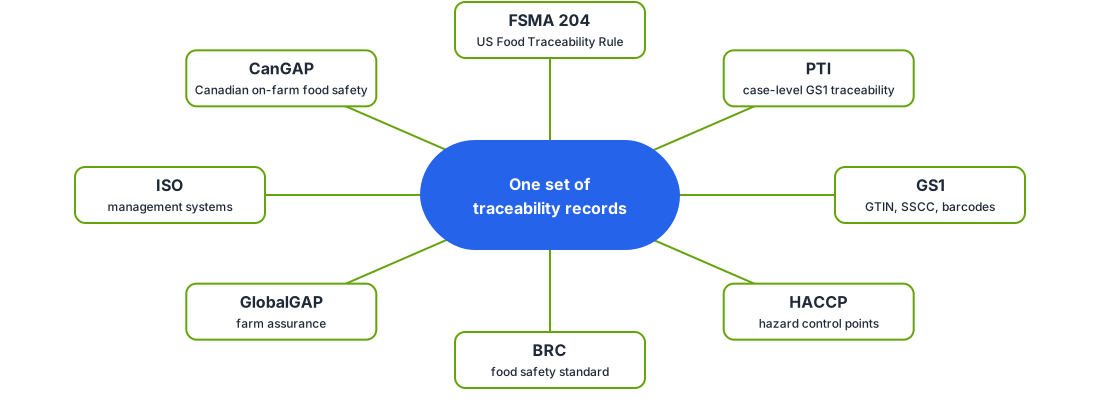
Many standards, one set of records
Fresh produce businesses face traceability requirements from several directions at once. Governments set food safety regulations. Retailers set supplier requirements. Certification schemes audit against their own standards. Export markets add rules of their own. Each asks for slightly different evidence, but almost all of them rest on the same foundation: accurate records of what was received, how it was handled, how it was transformed and where it went.
The efficient way to comply is to capture those records once, automatically and accurately, and present them in whatever form each standard requires. Farmsoft's traceability material lists support for BRC, GlobalGAP, ISO, HACCP, CanGAP and EuroGAP, and PTI, the Produce Traceability Initiative, with thousands of processes and guidelines integrated throughout the system.
FSMA 204: the FDA Food Traceability Rule
Section 204 of the US Food Safety Modernization Act led to the FDA Food Traceability Rule, the most significant traceability regulation for fresh produce in recent years. It applies to businesses that grow, pack, hold, ship, receive or transform foods on the FDA Food Traceability List, which includes many fresh produce items: leafy greens, fresh herbs, tomatoes, peppers, cucumbers, melons, sprouts, tropical tree fruits and fresh-cut fruits and vegetables, among others. It applies to foreign suppliers exporting covered foods to the United States as well as domestic businesses.
Key requirements
| Requirement | What it means | How Producepak supports it |
|---|---|---|
| Critical tracking events (CTEs) | Records kept at harvesting, cooling, initial packing, shipping, receiving and transformation | Scans at receival, packing and dispatch record each event |
| Key data elements (KDEs) | Specific data at each CTE: product, quantity, location, dates, traceability lot code | Captured automatically with each scan |
| Traceability lot codes (TLCs) | Assigned at initial packing, transformation and certain other events | Lots created in the system and printed on labels from the record |
| Traceability plan | A written plan describing how records are kept | Producepak workflows define how records are created |
| 24-hour retrieval | Records provided to the FDA within 24 hours, sometimes as a sortable spreadsheet | Linked records and recall reports; Pak-Bot for fast investigation |
The compliance date is 20 July 2028, after the FDA extended the original January 2026 date. This page is a summary, not legal advice; check the FDA's guidance for the requirements that apply to your products and role.
PTI and GS1
The Produce Traceability Initiative is an industry program in North America built on GS1 standards. PTI case labels carry a GS1-128 barcode encoding the GTIN and lot, with human-readable text and a voice pick code. Pallets carry SSCC labels. Farmsoft's traceability labels material lists SSCC, EAN, GS1, UPC, PLU and voice pick codes for crates, cartons, totes, pallets, cases and shipping containers, with PTI and retailer formats built in. Because labels are printed from the lot record, the code on the case matches the traceability record behind it. More detail is on the Fresh Produce Labels and AI site.
Certification schemes
Certification schemes audit traceability as part of broader food safety and quality management. Common requirements include documented traceability procedures, the ability to trace one step back and one step forward, regular mock recalls with recorded results, and records retained for a defined period.
HACCP
Hazard analysis and critical control points: monitoring, corrective actions and records at each control point.
BRC
A global food safety standard with traceability and recall testing requirements.
GlobalGAP
Farm assurance covering production and post-harvest handling, including traceability.
ISO
Management system standards that require controlled, documented processes and records.
CanGAP
Canadian on-farm food safety program for fruit and vegetables.
Producepak's quality control module is based on HACCP principles, and its inspections, alerts and records support audits under these schemes. See the Quality Inspection AI site.
Labelling compliance
Traceability compliance includes what is printed on the product. Farmsoft's traceability labels article notes that fruit and vegetables must carry the name of the food, product class is required for most produce, country of origin must be marked where omitting it would mislead, and treatments such as waxing must be disclosed. Retailer requirements add PTI, GS1 and customer-specific elements. Printing labels from system records keeps them consistent with the trace.
Audits and evidence
Compliance is proven at audit. Auditors typically select a product and ask the business to trace it, review mock recall records and check that procedures are followed. Farmsoft describes recalls, audits, mock audits and quality assurance compliance made easy and inexpensive. When every movement is captured and linked, an auditor's trace can be completed while they watch.
Audit readiness checklist
- Documented traceability procedure that matches how the system is used.
- Every receival, transformation and dispatch captured in Producepak.
- Labels printed from records at every level.
- Mock recalls run and recorded at the required frequency.
- Quality inspections linked to lots.
- Staff trained on scanning and on what to do in a recall.
Using AI for compliance work
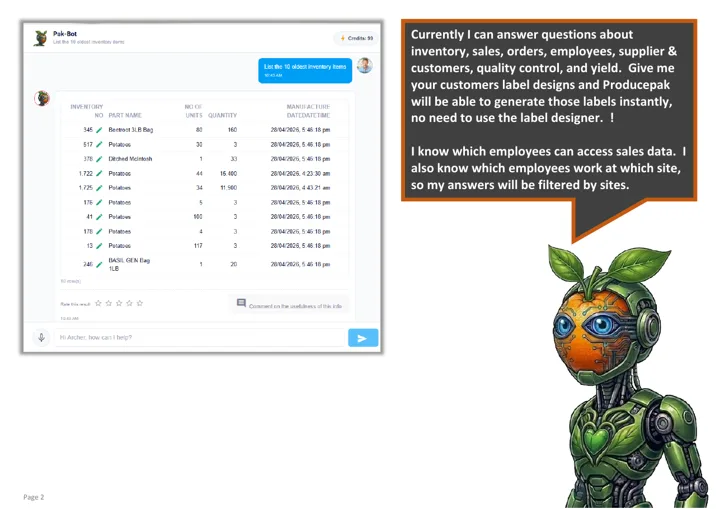
Pak-Bot answers questions about inventory, orders, suppliers and customers, quality and yield. During audit preparation and mock recalls, it can answer the questions an auditor asks, and email or print the results. Its permissions follow each user's role and site, and the Pak-Bot guide states that your data, excluding prompts, stays on Producepak servers rather than being sent to ChatGPT.
Starting with free compliance tools
Farmsoft's free food traceability app is described as traceability compliance software with labels in EAN, GS1, PTI, voice pick, SSCC, PLU and UPC formats, plus record keeping, recalls, mock recalls and audits, with no card required. It is a practical first step for small businesses preparing for FSMA 204 or retailer requirements.
Writing a traceability plan
FSMA 204 requires a traceability plan, and certification schemes expect documented procedures. A practical plan covers:
- the foods you handle that are on the Food Traceability List, or within the scope of your certification;
- how traceability lot codes are assigned;
- which critical tracking events you perform and which records you keep at each;
- where and how records are stored, and for how long;
- who is responsible, and a point of contact for regulators;
- how records are retrieved and provided within the required time.
When Producepak workflows capture records automatically, much of the plan describes how the system is used, which makes it easier to write and easier to follow.
Working with suppliers and customers on data
Traceability compliance is a supply chain effort. Under FSMA 204, key data elements and traceability lot codes are passed between businesses as product moves. Suppliers need to provide the information you must record at receiving, and you need to provide information to your customers when you ship. Agree with key trading partners what data will be exchanged and how, whether on labels, on documents such as bills of lading, or electronically. Chain-Trace codes on invoices, bills of lading, pallets and cases are one way to share traceability information with buyers.
Export market requirements
Exporters face the requirements of each destination market as well as their own country's rules. FSMA 204 applies to covered foods exported to the United States. Other markets have their own labelling, origin and traceability rules, and importers often add their own documentation requirements. Keeping one accurate set of records, from which export documents and labels are produced, is the simplest way to meet several markets at once. The Producepak app guide lists export documents among the documents the system produces.
A compliance calendar
| Frequency | Activity |
|---|---|
| Daily | Check that all receivals, lots and dispatches were scanned |
| Weekly | Review label errors, scan exceptions and stock discrepancies |
| Monthly | Reconcile stocktakes; review quality and traceability exceptions |
| Quarterly | Run and record a mock recall |
| Annually | Review the traceability plan, procedures and training |
| Before audits | Run a sample trace and check records are complete |
Building these activities into routine operations means compliance is maintained continuously, not rushed before an audit.
Record retention
Regulations and certification schemes require traceability records to be kept for a defined period. FSMA 204, for example, requires records to be kept for two years. Paper records are vulnerable to loss, damage and misfiling over that time; electronic records in Producepak are stored centrally and can be searched whenever needed. Check the retention periods for your markets and schemes, and make sure your procedures and system settings match them.
Compliance for multi-site operations
Businesses with several sites need consistent traceability everywhere. An auditor at one site may ask to trace product that was received at another, or transferred between them. Running every site in the same Producepak system, with the same scanning points and label formats, means transfers are traced like any other movement and compliance does not depend on which site is audited.
Training staff for compliance
Compliance depends on people following the process every time. Train receival, packing and dispatch staff on where to scan, what to do when a scan fails and why each record matters. Train supervisors to check scan compliance at the end of each shift. Train the recall team through mock recalls. Keep training records, as auditors often ask for them. Short, practical sessions, repeated when staff change, are more effective than long annual courses.
Compliance as a competitive advantage
Businesses that are confident in their traceability can say yes to opportunities others must decline: a new retail program with strict requirements, an export market with detailed documentation rules, or a customer who wants consumer-facing traceability. Compliance done well is not just a cost of staying in business; it opens doors to better customers and markets.
Compliance and quality together
Most food safety standards treat traceability and quality as parts of one system. HACCP control points, inspection records and corrective actions sit alongside lot records and recall procedures. When Producepak QI inspections are linked to lots, the evidence an auditor wants, such as what was checked, when, by whom and what happened when a check failed, is attached to the product it relates to. One integrated record answers both the traceability and the quality questions in an audit.
Compliance questions
Which traceability standards does Producepak support?
Farmsoft's traceability material lists BRC, GlobalGAP, ISO, HACCP, CanGAP, EuroGAP and PTI, with GS1-based labels including SSCC.
When must businesses comply with FSMA 204?
The FDA compliance date is 20 July 2028.
Does FSMA 204 apply to exporters?
It applies to foods on the Food Traceability List destined for the US market, including those from foreign suppliers.
Is there a free traceability compliance app?
Yes. Farmsoft offers a free food traceability app for labels, records, recalls, mock recalls and audits.