A recall is a race against time
When a food safety problem is suspected, every hour counts. Product may still be on shelves, in restaurant kitchens or in transit. Retailers want to know what to pull. Regulators want records. Customers want reassurance. The business needs to identify every affected lot, find where each one went, place any remaining stock on hold and notify the right people, all while continuing to run.
The outcome of a recall depends heavily on traceability. A business with precise, linked records can act within hours and limit the recall to the product actually affected. A business relying on paper and memory may take days and, unable to be precise, may have to recall far more product than necessary to be safe.
Precision limits the damage
Farmsoft's traceability material makes the point directly: accurate fresh produce traceability reduces the quantity of fruit and vegetables in a recall. If you can prove that only two lots are affected, you recall two lots. If you cannot, you may have to recall a whole day's production, a whole week or everything from a grower.
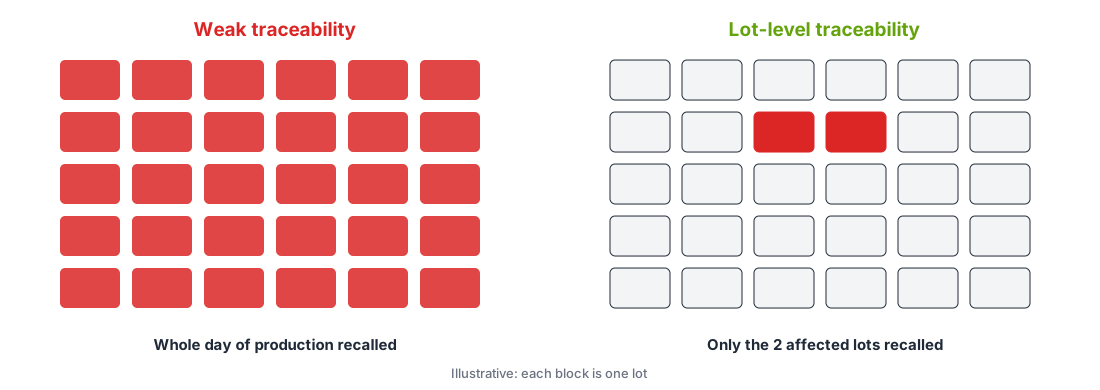
The costs of an over-wide recall go well beyond the product itself: retrieval and disposal, lost sales, retailer penalties, staff time and damage to the brand. Precision is the cheapest form of recall insurance there is.
The first questions in a recall
Every recall starts with the same handful of questions. How quickly you can answer them decides how well the recall goes.
| Question | Records needed | How Producepak helps |
|---|---|---|
| Which lots are affected? | Lot records, packing and transformation links | Lots linked to source bins and deliveries |
| Where did the product come from? | Receival records, grower and field details | Barcoded receival; trace back to supplier, crop, field or patch |
| Where did it go? | Dispatch, orders, bills of lading | Pallets scanned to orders; BOLs and proof of delivery |
| How much is still here? | Inventory by lot and location | Live inventory; RFID pallet positions; Pak-Bot questions |
| What did inspections show? | Quality records for the lot | Producepak QI inspections linked to lots |
The ProducepakQI guide describes tracing customer complaints back to the supplier or to the original crop, field or patch, and instant recalls. The Producepak traceability app page highlights instant audits and recalls.
AI in a recall
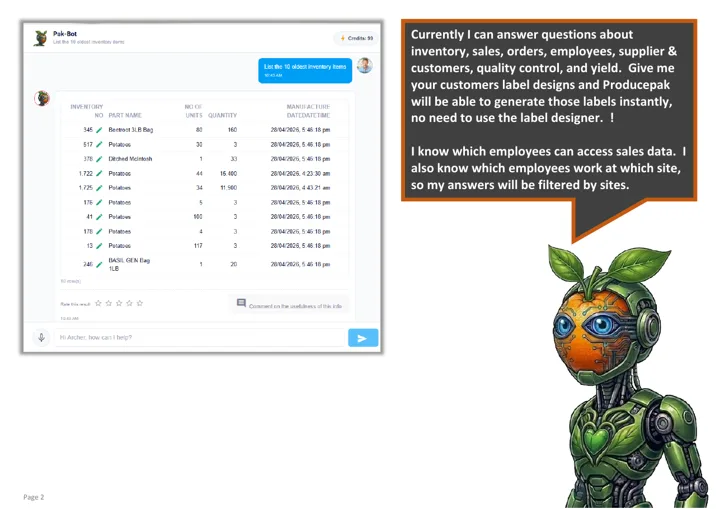
During a recall, people need answers faster than reports can be built. Pak-Bot answers questions about inventory, orders, suppliers and customers and quality in plain language. Questions such as "inventory from lot 4471 by site" or "customers who received lot 4471" can be asked as the investigation develops, depending on how your records are set up. Pak-Bot can also email and print results, so lists of affected customers and stock can go to the people making calls and placing holds. The Pak-Bot guide example Total of inventory at site Closters shows the kind of site-level stock question that matters when holding product across locations.
Remember: AI answers speed up the investigation; formal recall and regulator documentation should come from Producepak's traceability and recall features, checked by the people responsible.
Mock recalls: practise before it matters
Mock recalls test whether a business can trace a lot quickly and completely. Many certification schemes and retailers require them, and they are the best way to find gaps before a real incident does. Farmsoft describes recalls, audits, mock audits and quality assurance compliance made easy and inexpensive, and its free food traceability app includes recalls and mock recalls.
A mock recall in seven steps
- Choose a lot at random, ideally a case from the cool room or a customer delivery.
- Start the clock.
- Trace back: receival, grower, field or block, and harvest date.
- Identify other lots made from the same inputs.
- Trace forward: every customer and order that received the lots.
- Find all remaining stock by location.
- Stop the clock, record the time, and note any gaps or slow steps.
Repeat quarterly, with different products and sites. The time taken, and the number of gaps found, are the clearest measures of recall readiness.
The FSMA 204 24-hour requirement
In the United States, the FDA Food Traceability Rule requires businesses handling foods on the Food Traceability List to provide traceability records to the FDA within 24 hours of a request, and in some situations as an electronic sortable spreadsheet. The compliance date is 20 July 2028. A business that can complete a mock recall in minutes is well placed to meet that requirement. See traceability compliance.
Reducing the chance of a recall
Traceability limits the damage of a recall, but quality control reduces the chance of one. Receival inspections, temperature checks, corrective action alerts and supplier performance tracking catch many problems before product leaves the building. Integrated inspection records also mean that, if a problem does occur, the investigation can see what was checked and when. The Quality Inspection AI site covers this in detail.
Who does what in a recall
| Role | Responsibilities | Information needed |
|---|---|---|
| Recall coordinator | Leads the response, makes decisions, keeps a log | Full trace report |
| Quality manager | Investigates cause, reviews inspection records | Inspections and photos for affected lots |
| Operations | Places stock on hold, stops dispatch | Remaining stock by lot and location |
| Sales and customer service | Contacts customers, arranges retrieval | Customers and orders that received the lots |
| Purchasing or grower liaison | Contacts suppliers or growers | Source deliveries and growers |
| Management | Regulator and media communication | Summary of scope and actions |
Write these roles into your recall procedure and practise them during mock recalls. Pak-Bot's permissions mean each person can ask the questions relevant to their role and see the data they are allowed to see.
Communication during a recall
Clear, accurate and timely communication limits the damage of a recall. Customers need to know exactly which products, lot codes and dates are affected, and what to do with them. Regulators need complete records. Staff need to know which stock to hold. Precise traceability makes all of this possible: you can name the affected lots rather than whole product lines, which reduces confusion and keeps unaffected product on sale.
After the recall: finding the root cause
Once the immediate response is complete, the investigation turns to cause. Linked records make this possible: receival inspections, storage temperatures, packing records, transformation links and dispatch details for the affected lots can all be reviewed together. The answer may lie with a grower, a process step, a storage problem or transport. Fixing the cause, and updating inspection programs and procedures, is what prevents the next recall.
A recall readiness scorecard
- Can you trace any lot back to its grower and field in under an hour?
- Can you list every customer who received a lot in under an hour?
- Can you find all remaining stock of a lot, at every site, in minutes?
- Do you have a written recall procedure with named roles?
- Have you run a mock recall in the last quarter, and recorded the result?
- Are labels on your product printed from system records?
- Are quality inspections linked to lots?
Every "no" is a risk worth fixing before a real incident.
Where recall risks come from in produce
| Risk source | Examples | Controls that help |
|---|---|---|
| Field | Contaminated water, animal intrusion, chemical residues | Grower records, receival inspections, supplier performance |
| Harvest and transport | Temperature abuse, dirty bins | Receival temperature checks, bin records |
| Packhouse | Wash water, equipment hygiene, cross-contamination | HACCP controls, in-process inspections, lot records |
| Storage | Temperature failures, mixed product | Location tracking, stock rotation, inspections |
| Labelling | Wrong lot or allergen information | Labels printed from records, first-label checks |
Traceability does not remove these risks, but it means that when one does turn into an incident, the affected product can be identified precisely and quickly.
Recall costs that precision avoids
An imprecise recall multiplies costs: more product retrieved and destroyed, more customers contacted, more staff time, more lost sales while shelves are empty, and more damage to trust. Being able to say with confidence "only these lots are affected" keeps unaffected product in trade, keeps customer communication simple and shortens the whole event. That precision comes from the everyday discipline of scanning each movement and linking each lot to its inputs.
Holding stock across sites
When a recall involves product stored at several locations, every site must place the affected lots on hold at once. Live inventory by lot and location, with pallet positions recorded by scan or RFID, shows exactly where each affected pallet is. Site teams can be sent precise lists rather than general instructions, which prevents affected product from being shipped by mistake and avoids holding unaffected stock unnecessarily. Pak-Bot's site awareness means each site manager can ask about stock at their own location, while the recall coordinator sees every site.
Insurance, retailers and recall readiness
Retailers and insurers increasingly ask suppliers to demonstrate recall readiness, not just describe it. Being able to show recorded mock recall results, with times and completeness, and a written procedure with named roles, answers those questions convincingly. It can also strengthen a supplier's position when negotiating programs, because buyers know that a supplier with fast, precise traceability is less likely to cause them a costly, wide-ranging recall.
Recall readiness for small businesses
Small growers and packers sometimes assume recall planning is only for large companies. In practice, a small business is often more exposed, because a single recall can be a large share of its revenue and its customers may have less patience. A simple written procedure, scannable labels on every lot and a quarterly mock recall cost little and make a real difference. Farmsoft's free food traceability app, which includes labels, records, recalls, mock recalls and audits with no card required, is a practical starting point.
Recall risk questions
How does traceability reduce recall costs?
Accurate, lot-level traceability limits a recall to the product actually affected. Farmsoft notes that accurate traceability reduces the quantity of produce in a recall.
Does Producepak support mock recalls?
Yes. Farmsoft describes recalls, audits, mock audits and quality assurance compliance, and the free traceability app includes recalls and mock recalls.
Can complaints be traced to a field?
The ProducepakQI guide describes tracing customer complaints back to the supplier or to the original crop, field or patch.
How fast must records be provided under FSMA 204?
Within 24 hours of an FDA request. The compliance date is 20 July 2028.