Why accuracy is the whole point
An inaccurate trace is worse than no trace at all. It sends investigators in the wrong direction, recalls the wrong product, misses the affected product and gives customers and regulators false confidence. In fresh produce, where lots are mixed, repacked and split across many orders, a single wrong link can make an entire trace unreliable.
Most traceability errors are not caused by bad intentions or careless staff. They are caused by asking people to copy information by hand at speed: writing a grower code on a bin card in the rain, noting which bins went into a packing run on a busy line, copying lot numbers onto a dispatch document at 5 am. Every handwritten link is a chance for a mistake. The way to improve accuracy is to remove those links and let the system record what actually happened.
Barcodes at every step
Farmsoft's traceability material describes produce being barcoded on delivery to the packhouse, with traceability labels applied at many levels throughout packing and value-adding. Each scan records an event, with the product, quantity, location, time and user, and links it to the events before and after.
| Step | What is scanned | What the scan records |
|---|---|---|
| Receival | Bin, tote or pallet label | Grower or supplier, product, quantity, date, receival inspection |
| Storage | Pallet and location, or RFID read | Where each pallet is and when it moved |
| Packing | Input bins and output lots | Which source product went into which packed lot |
| Palletising | Cases onto pallet | Which lots are on which pallet (SSCC) |
| Dispatch | Pallets onto order | Which pallets and lots went to which customer, on which truck |
The Producepak app guide notes that USB or Bluetooth scanning devices that paste raw barcode data into the app can be used, which keeps hardware simple.
RFID: positions recorded without anyone noticing
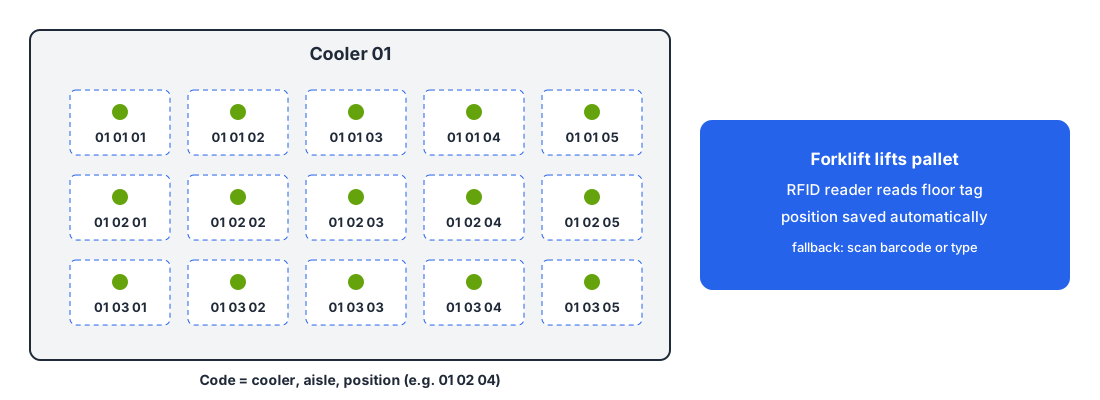
Cool rooms are where inventory accuracy is hardest to keep. Pallets are moved constantly, often in a hurry, and a pallet put in the wrong place can be lost for days. Farmsoft's RFID pallet control material describes a simple approach: RFID tags are placed at pallet positions, set into the floor, and a reader on the forklift identifies the position automatically when a pallet is picked up or put down. If a read fails, the driver can scan a barcode or enter the pallet number manually.
Practical details from Farmsoft's RFID guide
- Positions are coded by warehouse, aisle and position, for example "01 02 04" for cooler 1, aisle 2, position 4.
- Tags are embedded in the floor at each pallet space, with painted markings for alignment.
- Readers connect through a USB hub to Android tablets, using low-cost hardware with almost zero installation costs.
- Farmsoft reports a maximum read distance of about 24 cm with the cheapest readers; metal plates behind tags can boost range, and unpowered hubs can cut read distance by half.
- A test kit of about $130, with a reader, several tag types and a USB hub, lets you trial RFID before committing.
Farmsoft describes the result as 100 percent accurate and automatic fresh produce inventory traceability, with instant tracking at all times.
Lots linked to their sources
The most important link in produce traceability is the one between incoming product and packed product. When several growers' fruit is packed on the same line, the business must know which packed lots contain which growers' fruit. In Producepak, lots are created in the system as product is packed and linked to the bins and deliveries consumed. This is the link that lets a complaint about a carton be followed back to a grower, and the ProducepakQI guide describes tracing complaints back to the supplier or even to the original crop, field or patch.
Transformation and mixing
Fresh-cut processing, repacking and mixing create new products from several inputs. Each transformation should create a new lot linked to all of its input lots. Recording this in the system as it happens, rather than reconstructing it later, is the single biggest improvement many processors can make to trace accuracy.
Labels printed from the record
A label typed by hand can carry the wrong lot. A label printed from the lot record cannot disagree with it. Farmsoft's traceability labels material lists SSCC, EAN, GS1, UPC, PLU and voice pick codes for crates, cartons, totes, pallets, cases and shipping containers, and built-in formats including PTI, Walmart, Woolworths, Coles, Aldi and Tesco. Users can choose built-in labels, ask a Producepak consultant to add a design, or add their own.
Accurate orders, accurate forward trace
Forward traceability depends on knowing exactly what went to each customer. Farmsoft's traceability material claims 100 percent order picking accuracy with automatic traceability. When pallets are scanned onto orders, the forward trace records what actually shipped rather than what was planned. AI helps at the start of the process too: Pak-Bot converts customer documents into orders, so orders are entered as the customer wrote them, without retyping errors.
AI that checks and answers
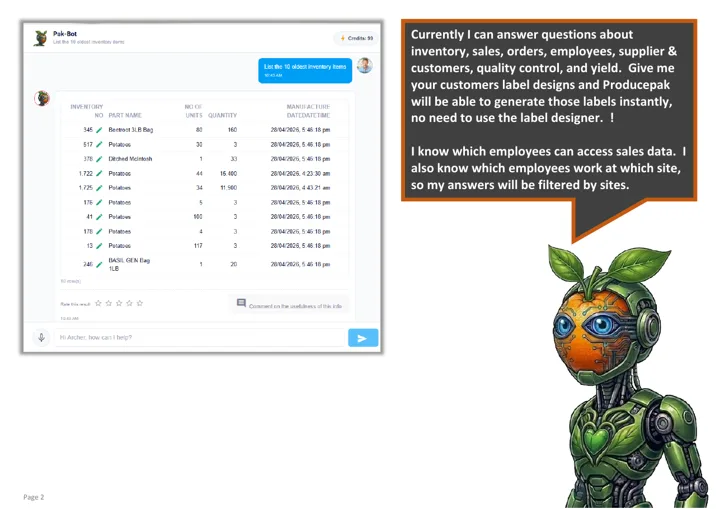
Accuracy also means being able to check records quickly. Pak-Bot answers questions about inventory, orders and quality in plain language, so staff can test the trace at any time. Questions from the Pak-Bot guide, such as Total yellow potato in stock or Total of inventory at site Closters, let a supervisor compare the system with the cool room in seconds. Differences found early are cheap to fix; differences found during a recall are not.
Accuracy checklist
- Every bin, tote or pallet is labelled at receival.
- Every movement is scanned or read by RFID.
- Every packed lot is linked to its source product in the system.
- Every transformation creates a new lot linked to its inputs.
- Every label prints from the record, never typed.
- Every pallet is scanned onto its order.
- Stocktakes are reconciled in the system.
- Mock recalls are run regularly to test the chain.
Common traceability errors and how to prevent them
| Error | Typical cause | Prevention |
|---|---|---|
| Bin recorded against the wrong grower | Handwritten bin cards, similar grower names | Barcode labels at receival; clear supplier records |
| Pallet in the wrong location | Moved without updating records | RFID position reads or location scans on every move |
| Lot not linked to its inputs | Run sheets incomplete or lost | Lots created in the system as product is packed |
| Wrong lot code on cartons | Labels typed or reused | Labels printed from the lot record |
| Pallet shipped but not recorded | Loading without scanning | Scan every pallet onto its order before loading |
| Stock count does not match system | Unrecorded movements, waste not recorded | Regular stocktakes reconciled in the system |
Accuracy in fresh-cut and value-added products
Fresh-cut processors face the hardest traceability challenge. A single bag of salad mix may contain several types of leaf from several growers, processed together and packed into many output lots. Accurate traceability means recording every input lot that went into every output lot. Doing this in the system as production happens, using scans of input containers, is far more reliable than reconstructing it later from production sheets. Farmsoft's blog lists fresh-cut fruits and vegetables among the products its traceability covers.
Measuring traceability accuracy
Accuracy can be measured. Useful indicators include:
- the percentage of stocktake lines that match the system without adjustment;
- the number of pallets that cannot be found at their recorded location;
- the completeness of mock recalls, meaning whether every lot could be traced both ways;
- the number of label errors reported by customers;
- the number of order errors found at delivery.
Track them monthly. Improvements show where automation is working; persistent problems show where a process step is still manual.
Training for accuracy
Technology does most of the work, but people still need to follow the process. Short, practical training makes the difference: show each team where to scan, what to do when a scan fails, and why skipping a scan breaks the chain. A one-page picture guide at each scanning point, and a quick check of scan compliance at the end of each shift, keeps standards high without slowing anyone down.
Quality records as part of the trace
A trace that shows where product went but not what condition it was in tells only half the story. Linking quality inspections to lots adds the other half. Producepak QI records receival, in-process and pre-shipment inspections with photos, and its guide describes tracing complaints back to the supplier or the original crop, field or patch. When an investigator follows a lot through the system, they see not just its movements but its quality at each stage, which makes it far easier to work out where a problem started.
Making the link reliable
- Inspect against the delivery or lot being checked, not as a separate record.
- Attach photos to the specific test they relate to.
- Record pre-shipment checks against the customer order.
With these habits, accuracy extends from what moved to how it looked when it moved.
Accuracy across the supply chain
Your records can only be as accurate as the information you receive and pass on. Ask suppliers to label bins or pallets with scannable codes, agree what information comes with each delivery, and give customers labels and documents they can scan in turn. Farmsoft's Chain-Trace approach applies codes to invoices, bills of lading, pallets, cases and consumer units so that each party in the chain can read the information the previous one recorded.
Accuracy and Pak-Bot permissions
Accurate answers also depend on people seeing the right records. Pak-Bot knows which employees can see sales data and which sites each employee works at, so a supervisor asking about stock sees their own site, and sensitive commercial data stays with the people who need it. According to the Pak-Bot guide, your data, excluding prompts, stays on Producepak servers and is not sent to ChatGPT. Accuracy and security go together.
Accuracy questions
How does RFID improve traceability accuracy?
Tags at pallet positions and a reader on the forklift record each pallet's location automatically, removing manual location records. Barcode or manual entry is the fallback.
What hardware is needed for RFID?
Farmsoft's guide describes low-cost RFID readers connected through a USB hub to Android tablets, with tags set into the floor at pallet positions, and a test kit of about $130.
How are packed lots linked to growers?
Lots are created in Producepak as product is packed and linked to the bins and deliveries used.
Can AI help check traceability records?
Yes. Pak-Bot answers inventory, order and quality questions in plain language, so records can be checked against reality at any time.