Start with the person, not the technology
The quickest way to get value from AI in a produce business is to start with the people who ask the most questions and give each of them a short routine. A routine is just a handful of questions asked at the same point every day or week. Once the routine is a habit, people naturally start asking new questions of their own.
This page sets out routines for seven roles found in most packhouses, grower groups and produce distributors. Every example uses Pak-Bot's current abilities: questions about inventory, sales, orders, employees, suppliers and customers, quality control and yield, plus email, print and labels. Page 2 of the Pak-Bot PDF guide summarises those abilities on one page.
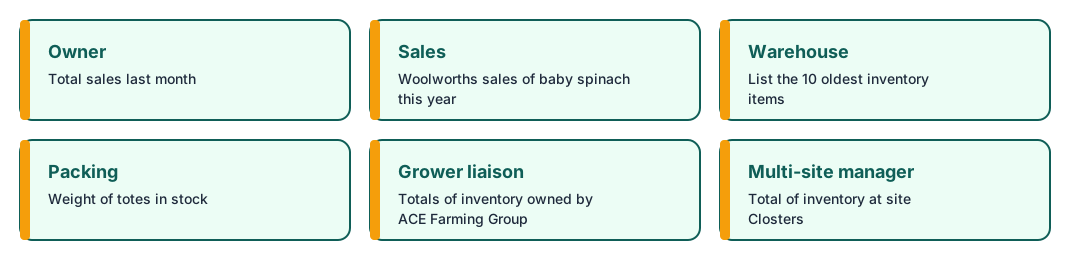
Owner or general manager
Owners need the shape of the business, fast, without waiting for month-end. They also need to check that what they hear in meetings matches the numbers.
Weekly routine
- Total sales last month, or last week, to see the headline.
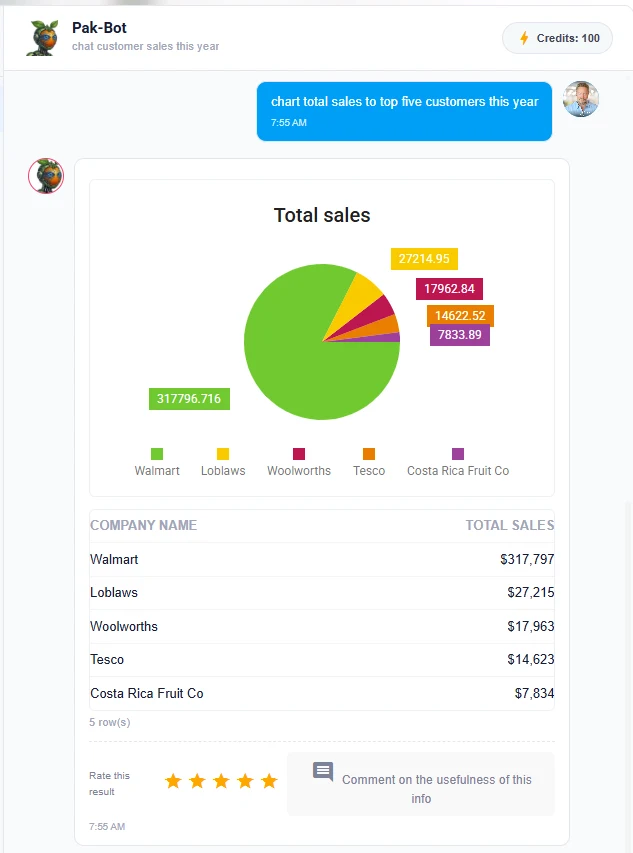
- chart total sales to top five customers this year to watch customer concentration.
- Sales by state last month for the regional picture.
- "Chart inventory by site" to see where stock is building up.
How owners use the answers
The top-five chart often starts the most important conversation of the year: what happens if the biggest customer cuts volume? Sales by state informs freight and depot decisions. Owners who ask these questions themselves also find they spend less time in meetings arguing about whose spreadsheet is right, because everyone can see the live figure.
Sales and account managers
Sales staff live on customer detail. They need to walk into every customer conversation knowing what that customer bought, ordered and received.
Before a customer meeting
- Woolworths sales of baby spinach this year
- Walmart orders vs sales Q1 2026
- "Chart [customer] sales by month this year"
Daily
- "Total [product] in stock" before quoting availability.
- List the 10 oldest inventory items to know what to offer first.
How sales staff use the answers
The orders-versus-sales comparison is the most powerful of these. Large retailers measure suppliers on fill rate; knowing yours, and the reasons for any shortfall, before the retailer raises it turns a defensive meeting into a constructive one. Quoting from live stock instead of memory prevents both short-shipments and unsold product.
Warehouse and cool room supervisors
Supervisors need to know what is physically in store, where and how old. Pak-Bot answers from the inventory records that scanning keeps up to date.
Daily routine
- Total of inventory at site Closters (your site) at the start of the shift.
- List the 10 oldest inventory items, printed for the forklift driver.
- Red onion in poly bags or other finished lines due out today.
How supervisors use the answers
The oldest-items list turns first-in, first-out from a rule into a pick list. Printing it takes one more request: "print the 10 oldest inventory items". Supervisors assigned to one site automatically see their own site's stock, because Pak-Bot knows which site each employee works at.
Packing managers
Packing managers plan runs from raw stock and orders, then watch how runs perform.
Daily routine
- Weight of totes in stock before setting the day's runs.
- "[Product] in bins" to see raw material by commodity.
- "Yield by line yesterday" to check how the lines performed.
How packing managers use the answers
Raw stock and orders together decide the run sequence: oldest intake first, earliest dispatch first. Yield by line flags graders, speeds or crews that need attention. Customer labels for each run can be generated from loaded templates rather than set up in the label designer, covered in orders and labels.
Quality managers
Quality managers need exceptions quickly and trends over time. Pak-Bot answers questions about quality control and yield from the inspections recorded in Producepak.
Routine
- "Inspections that failed yesterday" each morning.
- "Rejection rate by supplier this month" each week.
- "Yield by grower this month" for supplier conversations.
How quality managers use the answers
Daily failures drive same-day corrective action. Weekly supplier rejection rates give buyers and growers objective feedback. Emailing a grower their own results, straight from Pak-Bot, keeps the conversation factual and regular rather than occasional and heated.
Office and order-entry staff
Office staff field a constant stream of number requests and spend hours keying orders. AI helps with both.
Routine
- Use Pak-Bot to turn customer purchase order documents into draft orders, then check and release them.
- Replace recurring report requests with emailed answers, for example Email Angela Coles sales from Q1.
- Print documents and labels on request.
How office staff use the answers
When colleagues can get numbers themselves, office staff are interrupted less. When order documents are read by Pak-Bot, the early-morning rush shifts from typing to checking. Both free experienced people for the exceptions that need judgement.
Grower liaison and consignment staff
Businesses that pack or sell for growers need to keep those growers informed about product that is still theirs.
Weekly routine
- Totals of inventory owned by ACE Farming Group (each grower in turn).
- "Yield by lot for [grower] last week".
- "Email inventory owned by [grower] to [contact]".
How grower staff use the answers
A short, regular email to each grower prevents many phone calls and builds trust. Ownership questions only work because Producepak records who owns each item of stock, which is what makes Pak-Bot's answers precise rather than estimated.
Routines at a glance
| Role | When | Question | Action |
|---|---|---|---|
| Owner | Monday | Total sales last month | Review with managers |
| Owner | Monthly | chart total sales to top five customers this year | Customer strategy |
| Sales | Before meetings | Walmart orders vs sales Q1 2026 | Prepare fill-rate story |
| Warehouse | Daily | List the 10 oldest inventory items | Print for picking |
| Packing | Daily | Weight of totes in stock | Plan runs |
| Quality | Weekly | Rejection rate by supplier | Email suppliers |
| Office | Daily | Customer POs to orders | Check and release |
| Grower liaison | Weekly | Totals of inventory owned by ACE Farming Group | Email grower |
Access by role
Routines only work if each person sees the right data. Pak-Bot knows which employees can access sales data and which site each employee works at. A warehouse supervisor without sales access will not see sales figures, however the question is worded, and someone assigned to one site sees that site. Check these settings before giving routines to a team; see set up safely.
More roles that benefit
Dispatch and logistics
Dispatch needs to know what is going where, and whether it is ready.
- "Orders for delivery tomorrow by customer" to plan loading order.
- Sales by state last month to plan routes and freight.
- "Print orders for delivery tomorrow" for the loading team.
Buyers and purchasing
Buyers need supplier performance and stock cover.
- "Top 10 suppliers by weight received this year"
- "Rejection rate by supplier this quarter"
- "Total [product] in stock" before placing the next order.
Regional and multi-site managers
Managers responsible for several sites need comparisons.
- Total of inventory at site Closters, then "inventory by site".
- "Chart inventory weight by site" to see where space is filling.
Accounts
Accounts staff with sales access can answer customer and grower queries quickly.
- "Sales to [customer] last month"
- "Inventory owned by [grower]" during settlement questions.
For formal figures, accounts should still confirm against standard reports and the accounting system; Pak-Bot speeds up the investigation.
How to build your own role routine
- List the questions you ask others. For one week, write down every time you ask someone for a number.
- Turn each into a Pak-Bot question. Use the question formula from the ask well page.
- Test and refine. Ask each one, check the answer and adjust the wording.
- Attach each to a moment. Start of shift, before a meeting, Monday morning, month end.
- Add the action. Print, email or act on the answer.
- Share it. Give your routine to colleagues in the same role.
A calendar for the whole business
| Frequency | Questions |
|---|---|
| Every shift | Stock at your site; oldest items; finished stock due out |
| Daily | Failed inspections; yield by line; orders for tomorrow |
| Weekly | Sales last week; orders vs sales for key customers; grower stock and yield; supplier rejection rates |
| Monthly | Sales by state; top five customers; inventory by site; waste by product |
| Before meetings | Customer sales by product; fill rate; grower results |
The calendar is a starting point. Change it to fit your season, your customers and the decisions your business actually makes.
Use cases by type of business
Roles look slightly different depending on what the business does. The core questions stay the same; the emphasis shifts.
Packhouses
The heaviest users are packing managers and cool room supervisors. Raw stock in totes and bins, finished stock by pack format, the oldest items and yield by line are the daily questions. Customer labels generated from templates save time at every changeover.
Wholesalers and distributors
Sales staff and the order office lead. Availability by product, customer sales, orders against sales and purchase order capture matter most. Stock by site helps businesses with several warehouses.
Marketers and grower groups
Grower liaison and accounts staff lead. Stock by owner, yield by lot and emailed grower updates are the core. Totals of inventory owned by ACE Farming Group is the model question.
Importers and exporters
Arrival quality, stock remaining from each shipment and sales by customer or destination are the focus, along with order capture from overseas customers' documents.
Fresh-cut processors
Yield from raw material to finished product, quality checks and customer fill rates for food service and retail programs lead the list.
Common mistakes when introducing roles
- Giving everyone the same list. A warehouse supervisor does not need sales questions; tailor lists to roles.
- Too many questions. Five to ten per role is enough to start. People add their own later.
- No action attached. A question with no follow-up action is soon forgotten. Pair each one with what to do next.
- Ignoring permissions. If a role cannot see sales data, do not put sales questions on its list.
When roles work together
The biggest gains often come when two roles use the same answer. The warehouse prints the oldest stock list; sales sees the same list and offers those lines first to flexible customers. Quality emails a grower their rejection summary; the grower liaison follows up with the same figures. The owner charts customer concentration; the sales manager uses the same chart to plan account development. Because every answer comes from one set of live Producepak records, nobody argues about whose numbers are right, and the conversation moves straight to what to do about them.
Role questions
Which role should start using Pak-Bot first?
Whoever asks the office for the most numbers. In many businesses that is sales or the owner, followed by warehouse supervisors.
Can floor staff use it without a computer?
Yes. It works on phones and tablets, and questions can be spoken using the microphone button.
Will everyone see sales figures?
No. Only employees whose role includes sales access will see sales data.