Why wording matters
An AI chatbot connected to your data is only as precise as the question it receives. When a person asks a colleague "how are the spuds going?", the colleague fills the gaps from context: which spuds, which measure, which week. Pak-Bot fills gaps too, but it cannot read your mind. The more of the question you state, the less it has to guess, and the more likely the first answer is the one you wanted.
This page sets out a simple formula for produce questions, shows how to build on an answer with follow-ups, and lists fixes for the most common problems. Page 3 of the Pak-Bot PDF guide has ten example prompts; this page explains why they work.
The five-part question formula
Strong produce questions combine up to five parts. You rarely need all five, but knowing them helps you spot what is missing when an answer misses.
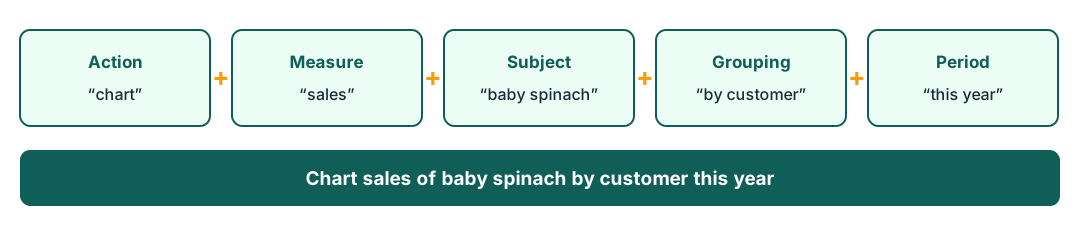
| Part | What it does | Examples |
|---|---|---|
| Action | Sets the form of the answer | total, list, chart, compare, email, print |
| Measure | What is counted | sales, units, weight, orders, yield, rejections |
| Subject | What it is about | a product, customer, grower, supplier, site, pack format |
| Grouping | How it is split | by customer, by product, by state, by week, by site |
| Period | When | today, last month, Q1 2026, this year, a date range |
Reading the guide's examples through the formula
- Woolworths sales of baby spinach this year: measure (sales), subject (Woolworths, baby spinach), period (this year).
- Sales by state last month: measure, grouping (by state), period.
- Weight of totes in stock: measure (weight), subject (totes); "in stock" means now, so no period is needed.
- Walmart orders vs sales Q1 2026: action (compare), two measures, subject, period.
- Email Angela Coles sales from Q1: action (email), measure, subject (Angela Coles), period.
Use the names Producepak uses
Pak-Bot matches the words in your question to records in Producepak. Customer names, product names, site names and inventory owners should be written the way they are set up. If the grower group is recorded as "ACE Farming Group", ask about "ACE Farming Group", not "Ace" or "the ACE boys". If the site is "Closters", say "site Closters", which also tells Pak-Bot that Closters is a site rather than a customer.
Pack formats and containers
Fresh produce exists in many forms: field bins, totes, cartons, clamshells, punnets, poly bags. Naming the form separates raw stock from finished stock. Red onion in poly bags asks only about finished poly-bag stock; "red onion in bins" asks about raw intake.
Be explicit about time
Dates are the most common source of misunderstanding. "Recently" means nothing to a database. "This month" on the 3rd covers three days. Seasons that cross the new year confuse calendar-based periods.
- Use standard periods: today, yesterday, last week, last month, this year, Q1 2026.
- When comparing, use complete periods or the same number of days.
- For seasons, give dates: "from 1 March to 30 June".
- For financial years that do not start in January, give the dates rather than "this year".
Ask for the form you want
The first word often decides the format.
| Start with | You get | Example |
|---|---|---|
| Total | One figure | Total sales last month |
| List | Rows of detail | List the 10 oldest inventory items |
| Chart | A chart with its table | chart total sales to top five customers this year |
| Compare / vs | Side-by-side figures | Walmart orders vs sales Q1 2026 |
| Email / print | The result sent on | Email Angela Coles sales from Q1 |
Follow-up questions
The fastest way to a precise answer is often a broad question followed by refinements. Each follow-up builds on the last answer, so you do not need to repeat everything.
A worked example
- Total sales last month gives a single figure, lower than expected.
- "By customer" shows one retailer is well down.
- "That customer's sales by product" shows one product line accounts for most of the drop.
- "Orders vs sales for that product last month" shows the customer ordered but was short-shipped.
- "Chart it by week" shows the shortfall was concentrated in two weeks.
Five short messages take a vague worry ("sales are down") to a specific issue that someone can act on. If Pak-Bot loses track during a long chain, restate the key details in full.
Speaking your questions
The microphone button lets you speak instead of typing, which suits the cool room, the packing floor and the car. Spoken questions follow the same rules: say the measure, the subject and the period clearly. Short sentences work better than long ones. If a name is often misheard, type that question, or use the version of the name that is easiest to pronounce if it is set up that way in Producepak.
When an answer misses: a troubleshooting table
| Symptom | Likely cause | Fix |
|---|---|---|
| No results | Name not recognised | Use the exact Producepak name; check spelling |
| Total far too high | Raw and finished stock mixed, or wrong period | Name the pack format; state the period |
| Wrong thing grouped | Ambiguous word, e.g. site read as customer | Add "site", "customer" or "grower" before the name |
| No sales figures | Your role does not include sales access | Ask a manager with access, or ask your administrator |
| Missing a site | You are not assigned to that site | Ask your administrator to check site assignments |
| Chart hard to read | Too many categories | Ask for the top 5 or top 10 |
Whatever the fix, add a comment to the answer that missed. Pak-Bot's guide asks for exactly this kind of feedback, which the team uses to train it.
Question patterns worth saving
Once a question works, save it. A short list of proven patterns, with your own names, is the quickest way to bring new staff up to speed.
Patterns to adapt
- Total [product] in stock
- [Product] in [pack format]
- Totals of inventory owned by [owner]
- Total of inventory at site [site]
- [Customer] sales of [product] this year
- [Customer] orders vs sales [period]
- Sales by [state / customer / product] [period]
- chart total sales to top [n] customers [period]
- List the [n] oldest inventory items
- Email [person] [result] [period]
What not to put in a question
Your business data stays on Producepak servers and is not sent to ChatGPT, but the wording of your prompt is used to interpret the question. Keep prompts to the question itself. There is never a reason to include passwords, bank details, personal information beyond names already in the system, or pasted contract text. If you find yourself pasting data into a prompt, stop: Pak-Bot already has access to the records it needs.
Practising with your team
A good way to build skill is a ten-minute exercise. Give each person three questions to ask: one they know the answer to, one they would normally ask the office, and one they have never been able to answer easily. Compare results, note which wording worked, and add the best questions to the team list.
Question examples by subject
Pak-Bot currently answers questions about inventory, sales, orders, employees, suppliers and customers, quality control and yield. Here is how the formula applies to each.
Inventory
Inventory questions usually need a subject (product, pack format, site or owner) and rarely need a period, because "in stock" means now.
- Total yellow potato in stock
- Totals of inventory owned by ACE Farming Group
- "Avocados older than 5 days"
Sales
Sales questions almost always need a period. Add a grouping to see where sales came from.
- Sales by state last month
- "Top 10 products by sales value this year"
Orders
Order questions often involve dates in the future ("for delivery tomorrow") or comparisons with what was shipped.
- "Orders for delivery tomorrow by customer"
- Walmart orders vs sales Q1 2026
Quality and yield
Name the measure clearly: failed inspections, rejection rate or yield.
- "Inspections that failed yesterday"
- "Yield by grower last 30 days"
Employees, suppliers and customers
Use names as recorded. Employee questions follow the same permission rules as everything else.
- "Employees at site Closters"
- "Top 10 suppliers by weight received this year"
A ten-second check before you press send
- Have I named what I am measuring?
- Have I used the names as they appear in Producepak?
- If it is about a period, have I said which one?
- Have I said whether I want a total, a list or a chart?
- Is there anything in the question that should not be there, such as a password or bank detail?
Five quick checks save most rephrasing.
Multilingual teams
Many packhouse and distribution teams include people for whom English is a second language. Short, simple questions work best for everyone: "Red onion in poly bags" is easier to write and easier for Pak-Bot to read than a long sentence. Giving staff a printed list of proven question patterns, with your own product and site names filled in, removes most of the difficulty. The microphone button also helps people who find typing slow.
Good questions versus great questions
| Good | Great | What changed |
|---|---|---|
| Potato stock | Total yellow potato in stock | Specific product and an action |
| Sales last month | Sales by state last month | Added a grouping |
| Walmart orders | Walmart orders vs sales Q1 2026 | Turned a list into a comparison with a period |
| Old stock | List the 10 oldest inventory items | Action plus a limit |
| Top customers | chart total sales to top five customers this year | Chart, measure, limit and period |
The "good" versions usually still work, but the "great" versions remove the guesswork and return exactly the view you need first time.
Keep it to one question
"Show me sales by state and the oldest stock and email Angela" mixes three requests. Ask them one at a time. Short questions are read more reliably, and each answer can be checked before moving on.
Questions that combine areas
Some of the most valuable questions cross departments, because Producepak holds sales, orders, inventory and quality in one place. Walmart orders vs sales Q1 2026 combines orders and invoiced sales. Inventory by owner combines stock with grower records. When a question spans areas, be especially clear about each part: which customer, which measures and which period. If the answer is not what you expected, split it into two simpler questions, check each, then try the combined version again.
Questions about asking questions
Does Pak-Bot understand casual wording?
Usually, yes. Casual wording works best for simple questions; for detailed ones, state the measure, subject and period explicitly.
Do I need to use special commands?
No. Plain English is enough. Words such as total, list, chart, email and print help set the form of the answer.
Why does Pak-Bot not recognise a product nickname?
It matches names in your Producepak records. Use the recorded name, and comment on the answer so the team can train Pak-Bot on common nicknames.
Can I ask about several things at once?
It is better to ask one thing at a time and build with follow-ups. Long multi-part questions are more likely to be misread.